Sunday, July 15, 2012

Amphitrion, The Infinities, Identity, Fidelity


It was during our senior year in high school, in the last week approaching Christmas break, that our English teacher surprisingly took us to a showing of Amphitrion (link).  We were giddy about being seniors, anxious for the "free life" of college campuses, or at least for the opportunity to work for ourselves.  Actor's Theater of Louisville had some professional actors, but to us they seemed like the young college students who would soon be our contemporaries.

My head was full of mush, but I didn't realize it back then.  I needed to work on myself, but I felt confident and superior and full of potential.  There was a suppressed sexual element to it, no doubt.  And an evolutionary oedipal and rebellious element.  All a part of the giddiness.

The play was held in a downtown loft.  The sexy and scantily clad actresses and actors ran up and down the aisles, and sometimes they looked us in the eye as they spoke their lines.  It was a performance like none I had seen before nor would not see again until I saw A Funny Thing Happened To Me On The Way To The Forum decades later at a dinner theater.  Amphitrion is that kind of a farce, adapted with seemingly impromptu burlesque and slapstick.

At its deepest level, like Shakespeare's A Midsummer Night's Dream, Amphitrion addresses the issues of identity, fidelity, and the sometimes jackassed nature of humans.  Both plays have mythic gods playing interference with human relationships.  Part of the comedy is in the rude awakening, the double-take of surprise when humans run up against the uncanny.

Ladies and gentlemen of the jury.  The actors ply their cases directly to the audience.  We'd seen this before--for instance, Dobie Gillis did it again and again under the statue of The Thinker--but that was television.

Amphitrion has its echoes elsewhere in our literature.  Shakespeare read it.  Most recently, John Banville used it in his novel, The Infinities, and Marie Phillips wrote a much more risque version in Gods Behaving Badly.  The Louisville Courier-Journal has a feature today on the Kentucky's Shakespeare Festival held annually each summer in Central Park.


Myths are something which never happened but are always happening.  The old stories never die.

Friday, July 13, 2012

Roberto Calasso, Tim Parks, Judi Dench, Shakespeare

The discussion of Greek myth and the Plato/Aristotle divide drew me back into Roberto Calasso's The Marriage of Cadmus and Harmony.  It is a delight it is to read this again.

We owe a debt, not just to the author, but to Tim Parks who translated Calasso from the Italian.  I paid little attention to Parks until I picked up a review copy of his memoir, Teach Us To Sit Still, a while back.  An amazing account of alternative medicine, mind over matter.  All the more profound because Tim Parks, the complete skeptic, is constantly gagging on the facts of his own experience.

The year is more than half over now.  It is not really midsummer, but summer came early this year and so did the high heat.  Shakespeare's A Midsummer Night's Dream actually seems set on the eve of the feast of John the Baptist, at the start of our calendar summer, in those normally lush and green-canopied days.
 
For several years, we ran in the Midsummer Night's Run, sponsored by Baptist Hospital in Lexington, a very lovely race beginning at 8:30 in the evening.  They always had Shakespeare on the shirts they gave away, with different colors every year.  I see that they are still running the race this year on August 11th.  If you are going to be in the Lexington area then, you can sign up for it now at this link. 

Harold Bloom, in his massive work on Shakespeare, says that he has never seen any good performances A Midsummer Night's Dream but one--the 1968 movie adaptation with an elite cast that included Paul Rogers as Bottom, Judi Dench as Titania, Helen Mirren as Hermia, Diana Rigg as Helena, and David Warner as Lysander.

Bloom points out that the play has four paradigms.  The mythic world of Theseus and Hippolyta, the four young lovers who are universal to every time and every place, Puck and the folklore fairy world, and the world of Bottom and his fellow English rustics.

Bottom's dream, his consciousness, has no bottom.  He is the natural man, like Huck Finn, self-confidently Aristotelian with no inkling of inferiority despite being at the bottom of the social and political hierarchy.  He is a weaver--a dream weaver, if you will, "whose awakened senses fuse in a synesthetic unity."
Judi Dench as Titania

"Bottom's parody of 1 Corinthians 2:9 (Geneva Bible) is audacious, and allows Shakespeare to anticipate William Blake's Romantic vision, with its repudiation of the Pauline split between flesh and spirit."              


All the world's a stage.  There is a play within the play, and the intellect explains the play to itself.  At the end, as Bloom points out, there is a unity between the selves, a synthesis of narrative between myth, fantasy, the individual, and the collective and in which man is at the same time author, director, player, and audience.


Wednesday, July 11, 2012

A Follow-up on Don Winslow's SAVAGES

Candy Minx, whose movie reviews can be found at this link,  dropped by to comment on my analysis of the movie, SAVAGES, in my last blog.


Thanks for stopping by, Candy.  We haven't seen the movie and don't intend to, at least until it comes out on television. The book's appeal to me is only in parable, which I think was an ambitious attempt at a stylized Greek tragedy (a la Cormac McCarthy's No Country for Old Men) about the violent side of human nature and the denial in which we are almost constantly immersed.  The human condition.

On the surface, the novel does not work nearly as well.

Ben may be capable of love, but Chon is not.  It is plausible that Ben would agree to $20 million dollars in ransom for O, but not plausible that Chon would do the same.

So Chon must agree to give up everything to get O back only because he knows that it means war, and he loves war more than anything.  Does O not say that, instead of orgasms, Chon has wargasms?

Chon's monologue says that Aristotle was right, that body and mind are one, that there is no divide, that we are all savages--hence the title of the book.  Later Ben's epilogue says that Plato was right, that if we do not recognize the better angels of our nature, we will destroy each other.

And indeed, at the end of the novel, that is what happens. What happens at the end of the movie?  I do not yet know, but perhaps Oliver Stone changed it.
 

The surface story is a simple war-over-a-woman-abducted tale, wide variations of which have been with us since before Homer told us the story of Helen and the siege of Troy.  History began with them.  They abound in our best western books and movies, such as Frank O'Rourke's A Mule For The Marquesa which was made into the Lee Marvin film, The Professionals.

According to which account you believe, Europa was either abducted or seduced and taken away by Zeus, which spawned a series of like abductions.  Roberto Calasso, in his great work on myth, says:

"Out of these events history itself was born:  the abduction of Helen, the Trojan War, and before that, the Argonauts' expedition and the abduction of Medea--all are links in the same chain.  A call to arms goes back and forth between Asia and Europe, and every back and forth is a woman, a woman and a swarm of predators, going from one shore to the other."


The variations of myth and history are always controversial.  Did the woman leave of her own accord?  Was she tempted and seduced by a snake?  Or was she violently carried away?  And no matter which way the story is told, the question remains:  Is she guilty or innocent?  And no matter how that question is resolved, is the war over her worthwhile?


Since ancient times, Herodotus and Aeschylus and Sophocles, the myth and counter-myth are retold.  Was Helen a slut and simply a macguffin, a piece of propaganda used to goad men into a merchant war?  Both O and Chon, in Don Winslow's novel, seem more interested in the act of sex than in love itself, something alien to their promiscuous and materialistic nature.

Ben suffers when O is kidnapped, and he suffers again when he kills a man attempting her release.  Ben is like an old man in a world where there is no country for old men.  The crossroads scene in the desert is a confrontation between Ben the dog and the wolves, but also between Chon the wolf and other wolves led by a cat woman.  Same/Same.  The fatally wounded Ben might as well have cried out, "Lobos and Leones."

Elena is more like a lioness than a wolf, but a predator just the same.  When she plans the kidnapping, she equates O with Helen of Troy, saying that "Men will do anything for this woman."  On page 133, as the plan dawns on her, she smiles cryptically.  The omniscient narrator says, "Yeah, it's a goddamn shame that Elena is allergic to feline dander, because it would be great to have a cat on her lap at that moment." 

The picture on the back of the dustjacket of the first edition of Don Winslow's SAVAGES has no savages, no drugs, no wolves, no dogs, no cats, no warriors, not even a gun.  The picture is of a naked woman, perhaps on a desert floor--mythic, a symbol of purity or cheap commercial eroticism, take your pick.  She could be Eve.  She could be Helen.  She could be a macguffin.  Anything a reader might make of her.  

Sunday, July 8, 2012

Don Winslow's SAVAGES: A Zen Analysis

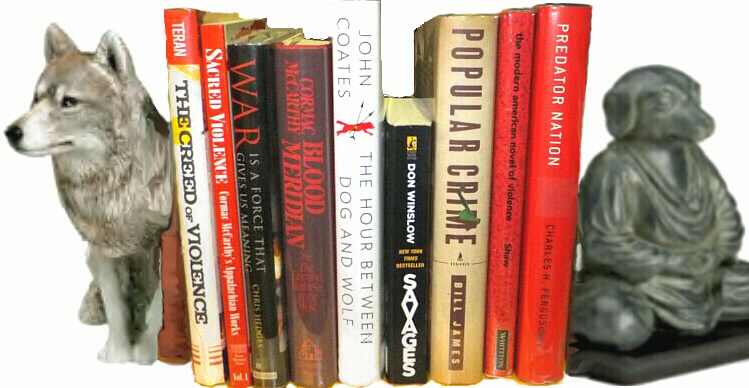
New on our shelves is THE HOUR BETWEEN DOG AND WOLF by John Coates, a senior research fellow in neuro-science at the University of Cambridge, formerly a Wall Street trader.  His book is relevant to the analysis at hand, of Don Winslow's novel, SAVAGES.

The epigraph to Dog And Wolf is from Jean Genet, and says that the hour between dog and wolf, twilight or sunset, "when the two can't be distinguished from each other," suggests a lot of other things besides the time of day.  The dog represents domesticated man, the better angels of our humanity, while the wolf represents the animal side of our origins, always with us though often in denial.

The trinity in Don Winslow's Savages consists of a relatively domesticated man in a business partnership with a relatively wolfish man who both have an affair with the same sensuous woman.  The more clean-cut dog man is a Democrat and is fond of some platonic and Buddhist ideas, while the hairy wolfish fellow tends to be aggressive, Republican, Aristotelian, and more cynical about human nature.  The woman who happily shares these two is an airy hedonist--a blonde bimbo, some might say.
 Ben the Dog, O, and Chon the Wolf

Stereotypes or archetypes, take you pick.  But not so fast--let's look further at this on the level of parable and at what the author says in the text.

The epigraph of Savages is a quote from John Mayall's song, "California," where "The sun never seems to go down."  The line is utopian and in denial of our animal nature, in denial of death.  Which brings us back again to the epigraph of The Hour Between Dog And Wolf, or if you prefer, to Cormac McCarthy's Blood Meridian or The Evening Redness In The West.  We recall that William Faulkner's original title to The Sound and the Fury was Twilight.

Life may be a tale told by an idiot, full of sound and fury, but for all its imperfections, life is good and we hate to see that evening sun go down.  The woman who lives in paradise with these two men is named Ophelia but she is referred to as O, which is aptly nothing or emptiness in the Buddhist sense.

O rattles off popular phrases and Internet slang no end.  She's a shopaholic and addicted to sex, drugs, new duds and everything else in this consumers' world.  She enthusiastically alternates between the dog and the wolf, and in one of the many sex scenes, she takes them on at the same time, one in the front and one from behind.

You might say that O represents the public at large.  They get mindlessly fucked by both dog and wolf, unaware of the addictions that enslave them.  Ben the dog represents businessmen.  I see him as a working dog--a labrador, say.  He does some good things, but to do them he has ignored the Buddhist dictate for right livelihood, and instead has catered to the public's addictions, enabling their denials of death and hence of life.  

O not only gets fucked at both ends, but both front and rear at the same time, and the worst part about it is, she likes it--as addicts always like their fix.  She craves it.  She can't get enough.  Ben tells her that she is just trying to fill her inner emptiness.  That it is a futile task.  He gives her other bits of secular Buddhist advice as well.

Ben the buddhist dog tries to make peace with the violent drug cartels who want him to work for them.  He wants to quit the addiction business altogether and go into the businesses that help people--alternative energy and humanitarian projects.  Chon the wolf says that this will only be interpreted as weakness by their enemy, and of course that's what happens in the novel.  O then gets kidnapped, held hostage in the drug war.
How does SAVAGES measure up to major studies of violence?

Chon the wolf has an interesting monologue, where he equates capitalistic economics with war.  Very Aristotelian.  But the real epilogue comes later on page 346 of this airy 358-page novel.  It is very cynical, critical of Ego, and the narrator must be the author:  "...We went to the beach, rode the waves, and poured our waste into the water we said we loved. . .We made gods of wealth and health.  A religion of narcissism.  In the end, we worshipped only ourselves.  In the end, it wasn't enough."

Some people have said that this epilogue of Savages took them by surprise, rather like the cryptic epilogue in Blood Meridian, at the sunset of the novel.  But I hear it in the voice over of Rod Serling, like the  ending of "The Monsters Are Due On Maple Street," an episode of The Twilight Zone.

But then, there is a crossroads, and a decision to be made, and I understand that Oliver Stone tacked on an alternative ending for the movie that opened last week.

The conclusion or epilogue of The Hour Between Dog and Wolf finds John Coates arguing for Aristotle against Plato in our view of the divide between body and mind:  "We may thrill to the ethereal beauty of Plato's vision, but we feel at home with Aristotle."  

Coates then warns against utopian visions on both sides:  "Unearthly ideals, we have learned at great cost, too easily lead to social and political disasters.  Equally, other worldly ideals of economic rationality can too easily lead to the design of a marketplace fatally prone to financial crises."

Beware of the utopian socialists, he says, but also beware of the utopian free-marketers.  Right now it is the Ayn Rand Utopians who bring us ever closer to the abyss.


See my review of the Ayn Rand Utopian Fantasy at this link.


See my review of Don Winslow's The Gentlemen's Hour at this link.
Does the path truly lie between the dog and the wolf?

Tuesday, July 3, 2012

Dobie Gillis, Maynard, and The Thinker

My wife and I recently watched the first two seasons of Dobie Gillis, which premiered back in September, 1959, just in time for the school year back then.

Dobie first appears under a reproduction of Rodin's statue, The Thinker, a bit of irony since the show was decidedly anti-intellectual.  It had the ambiance of a high school play on a threadbare stage, using catch-phrases time-after-time, as when Dobie's father repeatedly says, "I gotta kill that boy," with deadpan Freudian overtones.  Dobie's mother is always pointing out that the father was just like Dobie when he was young. 

The series was based upon Max Shulman's 1953 book of campus stories, The Many Loves of Dobie Gillis.  Shulman was also the main scriptwriter for the TV series, for which he added a completely new character, Maynard G. Krebs.  Krebs was supposed to be a beatnik, but as no one at the studio knew what a beatnik was, Shulman said he started hanging out in college campus dives to observe them, and he eventually came up with this composite character.

Maynard started out as comic relief, but when Shulman tried to write him out of the show, it turned out that Maynard was the main reason a lot of people bothered to watch it.  Maynard then became a fixture, America's iconic beatnik.

According to Bill Morgan's biography of Allen Ginsberg, the term "beatnik" wasn't coined by an American newspaperman until 1958, in the surging Red Scare after the Russians launched Sputnik (see the Wikipedia link).  Jack Kerouac had written of "the beat generation" a decade before, of its non-comformist anti-materialism.  Maynard's anti-materialism was equated with good-for-nothingness and sloth on television.
Statuesque teen Tuesday Weld:  Think $

And Dobie too, at least in the early episodes, works harder to get out of work than he would if he actually picked up a broom and started helping his father at the store.  But Dobie's sense of love is certainly materialistic.  He doesn't love, he craves possession, and he judges girls only by their surface beauty.

Thalia, the main object of his desires, is driven by her interest in money and material possessions.  This is nicely played by Tuesday Weld, who Dwayne Hickman remembers as "fifteen going on thirty."  But it seems like the longer the show continued, the more shallow and pointless it became, laugh track and all.

Beatniks may have turned into hippies, as they say, but before the word "beatnik" was coined, there were hipsters.  Max Shulman must have been inspired by Kookie, a character on Roy Huggins' detective show, 77 Sunset Strip, which also used a jazz soundtrack (link).  Perhaps he was also inspired by the jazzy bongo-playing Greenwich Village warlock played by Jack Lemon in Bell, Book, and Candle.

The beats are rightly associated with bebop jazz, and Maynard was often talking about Dizzy Gillespie and Thelonious Monk.  Perhaps the mere mention of them on the show inspired some college kids to give them a listen.  The success of the show inspired many others, including the Scooby Doo cartoons and perhaps even some of the mindless shows that are around today--if so, we won't be found watching them.


We'd much rather listen to Chano Pozo, Dizzy Gillespie, and Thelonious Monk.
Gabriel Solis, author of MONK'S MUSIC

Sunday, July 1, 2012

Jazz and Noir and Too Darn Hot

August came early this year, like nearly everything else.  Some like it hot, but not this hot.  There was nearly a week of record-breaking +100 temperatures, to be followed now by a week in the high nineties.  Too darn hot.


So that's what we're listening to:  Claire Martin's version of "Too Darn Hot."  Or Ella Fitzgerald's take on it.  We also like Jewell's up-tempo version, also jazzy, almost be-bop.


And other slow torch songs for sweltering nights ducking in and out of the blast.  The corn is high, but the grass is burning, the earth cracking, the garden forlorn and doomed.  You can't water it fast enough.  Creeks dry up and ponds recede.  Too early for this stuff.  Record hot and record itchy.  A seven-year itch?  No, a hundred-year itch.


If it is like this now, what are the dog days going to be like?


Jimmy Rodger's version of "The Long Hot Summer."  Julie London.  Diana Krall.  Etta James.  Peggy Lee.  Dinah Washington.  Tina Turner.  The late Donna Summer.  Hot, hot, hot, hot--stuh...ufff.  Hot, hot, hot, hot.

The only suitable entertainment is comedy or noir, one release or the other, take your pick.  Only jazz can express the full measure of this tension, this angst.

There was a desert wind blowing that night. It was one of those hot dry Santa Anas that come down through the mountain passes and curl your hair and make your nerves jump and your skin itch. On nights like that every booze party ends in a fight. Meek little wives feel the edge of the carving knife and study their husbands' necks. Anything can happen.  You can even get a full glass of beer at a cocktail lounge.

The Irish Sense of Rebellion; From Elvish to Klingon to Quotation Marks

Just the other day, I blogged about James Cooke Brown who, among other things, invented a logical language.  Cooke's language "was designed to test the theory that natural languages limit human thought" by using "symbolic logic made speakable."

What caught my eye today was last year's anthology FROM ELVISH TO KLINGON: EXPLORING INVENTED LANGUAGES, edited by Michael Adams.  An essay here touches upon Brown's lawsuit concerning his invention, but mostly they discuss the invented vocabularies of novelists down through the ages.  Chapter seven is entitled "Oirish Inventions: James Joyce, Samuel Beckett, Paul Muldoon" by Stephen Watt:


"It is a widely accepted fact, perhaps even a cliche, that much significant Irish literature of the twentieth century adopts a peculiar, even adversarial, stance towards established languages.  At times, this antipathy emerges in what are finally minor rebellions against grammar, syntax, and convention.'


"So, for example, Bernard Shaw at times eschewed apostrophes when writing contractions and invented a method for indicating verbal emphasis in which spaces were added between letters, in this way, revolt became r e v o l t.  James Joyce avoided quotation marks when writing dialogue, perhaps the least radical of his myriad experiments with language leading inexorably to Finnegans Wake.  Sometimes, however, the struggles between artist and convention are waged over somewhat larger stakes than marks of punctuation and, not surprisingly, the most vexed of these obtains between Irish writers and the English language an uneasy mesalliance."

Cormac McCarthy, who has named James Joyce's Ulysses as one of his four favorite novels, doesn't use quotation marks either.  He says that they're unnecessary, but of course the real reason lies in the Irish rebellion against formal language mentioned above.  It is the nonconformist attitude best seen in his autobiographical novel, Suttree, as well as in Blood Meridian.

New York's White Horse Tavern:  From Dylan Thomas to Jack Kerouac to Bob Dylan
Bob Dylan, in THE CHRONICLES, volume one, writes of the scene in New York, and says that what attracted him was not protest songs, but "songs of rebellion,"  Oedipal perhaps, but still songs of the disenfranchised, of the dispossessed and most importantly, of the natural alienation felt by the thoughtful spiritual mind conscripted into this temporal physical existence.

Dylan says he started going to the White Horse Tavern on Hudson Street, which was then mainly an Irish bar.

"All through the night they would sing drinking songs, country ballads and rousing rebel songs that would lift the roof. The rebellion songs were a really serious thing."

"The language was flashy and provocative--a lot of action in the words, all sung with great gusto. The Irish singer always had a merry light in his eye--had to have it. I loved these songs...even in a simple, melodic wooing ballad there'd be rebellion waiting around the corner. You couldn't escape it."