Friday, March 4, 2011

Friday's Forgotten Book: Neil Gunn's BLOOD HUNT


BLOOD HUNT by Neil M. Gunn, first published in London by Faber & Faber, 1951.  My copy is the 2007 trade paperback edition, scanned above, available at Amazon.

 This book shares its title with an Ian Rankin (Jack Reacher) thriller, and also with a number of other westerns and mysteries.  Neil Gunn's 
Blood Hunt is probably the most forgotten of the bunch.  It is a crime novel but, like Wendell Berry's Watch with Me that I discussed here recently, one in which the protagonist steps out of the duality, breaking the cycle of confrontation and revenge.  Thus it too does not fit the standard formula of genre.

American publishers usually insist on the formula, though some exceptions immediately come to mind--Leif Enger's
Peace Like a River and Daniel Woodrell's Winter's Bone: A Novel.  Like these, Neil Gunn's Blood Hunt is a crime novel, but one with pastoral and naturalistic elements.
The protagonist, Sandy, is a widower who retires from the sea to live out his remaining days in the pastoral highlands.  A local village boy involved in a love triangle kills his rival in a fight and runs off.  Sandy befriends the lad who is being hunted by the police.  The plot is simple, but the story is driven by Gunn's characterizations and the underlying mythic and naturalistic motifs.


After reading this one, I came on-line to search for the author's other works, especially his novel The Well at the World's End (Canongate Classic) and his autobiographical The Atom of Delight.  I also read John Burn's excellent study of the author, A Celebration of the Light: Zen in the Novels of Neil Gunn.  I highly recommend all of these.


This is a tag-along to Pattinase's Forgotten Book Friday series.  Be sure to check out this week's other entries at these links:
Patti Abbott
Joe Barone
Eric Beetner
Paul Bishop
Paul Brazill
Bill Crider
Scott Cupp
Martin Edwards
Jen Forbus
Cullen Gallagher
Randy Johnson
George Kelley
B.V. Lawson
Evan Lewis
Steve Lewis
Todd Mason
John Norris (to come later)
Richard Pangburn
David Rachels
James Reasoner
Gerard Saylor
Ron Scheer
Kerrie Smith
Kevin Tipple

Be sure to check out J. F. Norris's entry at my favorite crime novel blog, The Rap Sheet.  The link is here.

Thursday, March 3, 2011

Wednesday's Western: Robert Flynn's ECHOES OF GLORY


Robert Flynn's Echoes of Glory, was published in 2009 by TCU Press, Fort Worth, Texas, in trade paperback.  The cover illustration, credited to Vicki Whistler, is fine and fitting with the themes of the novel, but I wish that this had been published instead in a magnificently deluxe hardcover, in a larger, easier-to-read font, with a sturdy bulk suggesting its considerable substance.

I first heard of it when it won the 2010 Spur Award as best western novel of the previous year, and I counted it among the very best new novels out of hundreds I've read in the last few years.  It is a modern western set in Texas during the Reagan administration, part parable, part satire, part social commentary, and all together just a hell of a good novel.


Opening lines:  "Sheriff Timpson Smith lumbered through the dim, drafty Mills County Courthouse, his bootheels gunshots on the on the wooden floor.  The courthouse--a stone breadbox with a metal birdcage for a bell tower--was not built for grace or beauty but for the assertion of authority."

"Lumbered" is the right word, for the sheriff and the courthouse are built the same way in the imaginations of the population.  The people of the county trust their sheriff, a Korean War hero who had served in the legendary outfit recruited from their county, many of whom had been killed.  Sheriff Smith was a very reluctant war hero, always haunted by guilt about it and trying to compensate in the manner of some other kindred fictional Texas sheriffs--James Lee Burkes's Sheriff Holland of Rain Gods: A Novel and Cormac McCarthy's Sheriff Bell of No Country for Old Men.

Echoes of Glory is set in a mainstream Texas which is neither east nor west, " a philosophical rather than geographical distinction.  East Texas was closer to the plow than to the horse, closer to Gettysburg than to Little Big Horn, closer to plantation than to reservation.  West Texans favored wild over tame, believed that God's gifts to men were guns, dogs, women, and pick-ups evolved from horses; more inclined to drygulching than lynching, to fighting than reasoning.  Mills County was in the center whether you said branch or bayou, arroyo or gully."    

People trust Smith, their war hero sheriff, but they don’t trust politicians in general, such as Mayor Williams:

“Williams was mayor because his older brother, the one you could count on, died with Second Platoon and because voters didn’t like certainty in public office. Except for sheriff. There, certainty was important and if the sheriff said someone was guilty they probably were or they wouldn’t have been arrested.  Trials were for show like weddings for couples who had been living together for years.”
As the story opens, the trusted sheriff is about to retire and will most likely be succeeded by his most macho deputy.  The deputy is dispatched to quell a dispute between neighbors and shoots and kills a man, who brandished a gun but was about to surrender.  This incident sets the story in motion.

For the man shot was an old "war hero" too, from the same outfit as the sheriff, and he was also one of the county's Mills family, legendary in Texas history and for whom the country had been named.

“The Mills family had an outdated code of honor that made them seem combative. They required an honesty that some found intimidating. Quick to laugh, they were fierce when threatened, and sensitivity to menace had passed from father to child. The Mills required a lot of space.”

The small incident gathers lies and legends in parallel with the larger events of history, the Korean War incident and the Battle of the Alamo itself.  The small distortions of legend universally echo the larger ones.  The author evinces a fine grasp of human nature, and his wordplay and humor are subtle and often take you by surprise.

The sheriff "had believed in God, believed in America; they were almost synonymous," but he finds now that there is a difference between the county's poor old spiritual church and its modern monied church endorsing capitalism:

". . .poor uneducated Bible punchers preaching a stern God who expected his followers to work hard, to act with mercy and humility, and to expect nothing from this world.  Not power, not riches, least of all justice.  'The Lord will repay," they proclaimed.  The frontier had passed and with it those inclined to wait on the Lord.  Folks gravitated to churches like Pastor Murphy's Solid Rock Church where a benevolent God required only a little earnest money before pouring out his blessings on his chosen.  God repaid donors to Murphy's church and school tenfold tenfold what they had given, dollars to those who needed dollars, dollars for days for those who needed days.   'That's a better deal,' folks agreed, even in Mills County where God previously repaid good deed and charity in the hereafter."
The pastor of the poor church "never asked why bad things happened to good people; salvation was not a rabbit's foot and he didn't need the threat of everlasting punishment to believe.  Why good people did bad things to others in the name of goodness was something he pondered every day."

The novel is set during the 1980s, some thirty years ago, but even then, people "loved rugged individualism in books or on the screen," but not in real life "where there was less of it every year.  Mom and pop stores had disappeared" and everything was owned by corporations, and neither corporations nor elected officials were accountable.

Despite winning the Spur Award, this novel elsewhere seems to have flown under the radar as few people placed it on their year-end best lists, neither last year or the year before.  Well, it was on mine.

The author's website is at this link.  I haven't yet read any of his other novels except for North to Yesterday (Texas Tradition Series), which is a great trail drive novel, a western parable featuring father/son bonding.  I'll review it in this space one day soon.  

Tuesday, March 1, 2011

Mindfulness Monday: A Separate Peace

Sunday I caught the tail end of a segment on Book TV, a rant given by an author of a couple of books on my "most beloved" shelves, Chris Hedges.  I've enjoyed them all, but his best two books, in my opinion, are  War Is a Force that Gives Us Meaning and Losing Moses on the Freeway: The 10 Commandments in America.  I suspect that these two will last when the others are long out of print.


His two most recent books are Empire of Illusion: The End of Literacy and the Triumph of Spectacle and Death of the Liberal Class.  At the end of his talk, he fielded questions from the audience.  People wanted to know, What's to be done?


Chris Hedges wisely refused to take a stand on many things, said that he was simply an investigative journalist who had diagnosed the illness, not knowing a cure for the disease.  He said that he was anti-authoritarian by nature, but not one to start or join causes.


Indeed.  Liberals have no cause to join anyway.  The only cause in American life left to attract true believers, in the Eric Hoffer sense, is the Tea Party.  Initially manufactured by Fox News with the help of Rush Limbaugh, Glenn Beck, and other demagogues in the fold of the Super Rich, it has now grown to a formidable force.  The main doctrine of the Tea Party is that laissez-faire capitalism is the American Way and should be fully implemented.  True believers, looking for a cause to join, flock to their side.  It's like Orwell's 1984, in that the ruling rich have thus created their own underground.


What's to be done?  There's no stopping them now, and the hard lessons of history will have to be learned all over again.  The Supreme Court may have sealed the new U. S. Plutocracy forever by recently decreeing that corporations were equal to citizens and that corporations might sponsor political candidates with unlimited funds.  Rule by the rich--that's what it amounts to.  It could be argued that we have always been ruled by the rich, but never before to such an official degree.

Hemingway Award-winning author Sean Murphy, in his satirical novel entitled The Time of New Weather (2005), envisioned a corporation buying out the United States Government.  Stands to reason, that if private enterprise is as efficient and government is as inefficient as Rush Limbaugh claims, then the government should naturally be run by private enterprise.

So what's to be done?  Nothing.  Just let it be.  You can still speak out against it, flamboyantly as Chris Hedges does in Death of the Liberal Class, or more quietly as Wendell Berry does in The Way of Ignorance: And Other Essays.  But in the meantime, I recommend that you make a separate peace with the world as it is, and simply do what you can on a personal level to make the world a better place.

Like Wendell Berry (and Chris Hedges too), I'm not one for causes.  All causes eventually give rise to an anti-cause in opposition, and it becomes true believer vs. true believer, ditto heads vs. ditto heads.  You need to step out of the duality; and you do that with the realization that these people who seem malicious are merely ignorant, caught up in the duality of competing immortality projects--blindly giving lip service to freedom though it is not freedom they seek, it is substance to fill their emptiness, and control over death.

And it is both sides of the duality that seek this control, under the delusion that they are pursuing freedom and justice.  We should forgive our debtors, but the justice-seeking duality will not permit it.  It wants to even the score, and not only that, it demands payback and a pound of flesh besides.  Justice is not what we need; compassion is what we need.  Compassion and forgiveness.  You should read Margaret Atwood's masterful work on debt(pictured at left).

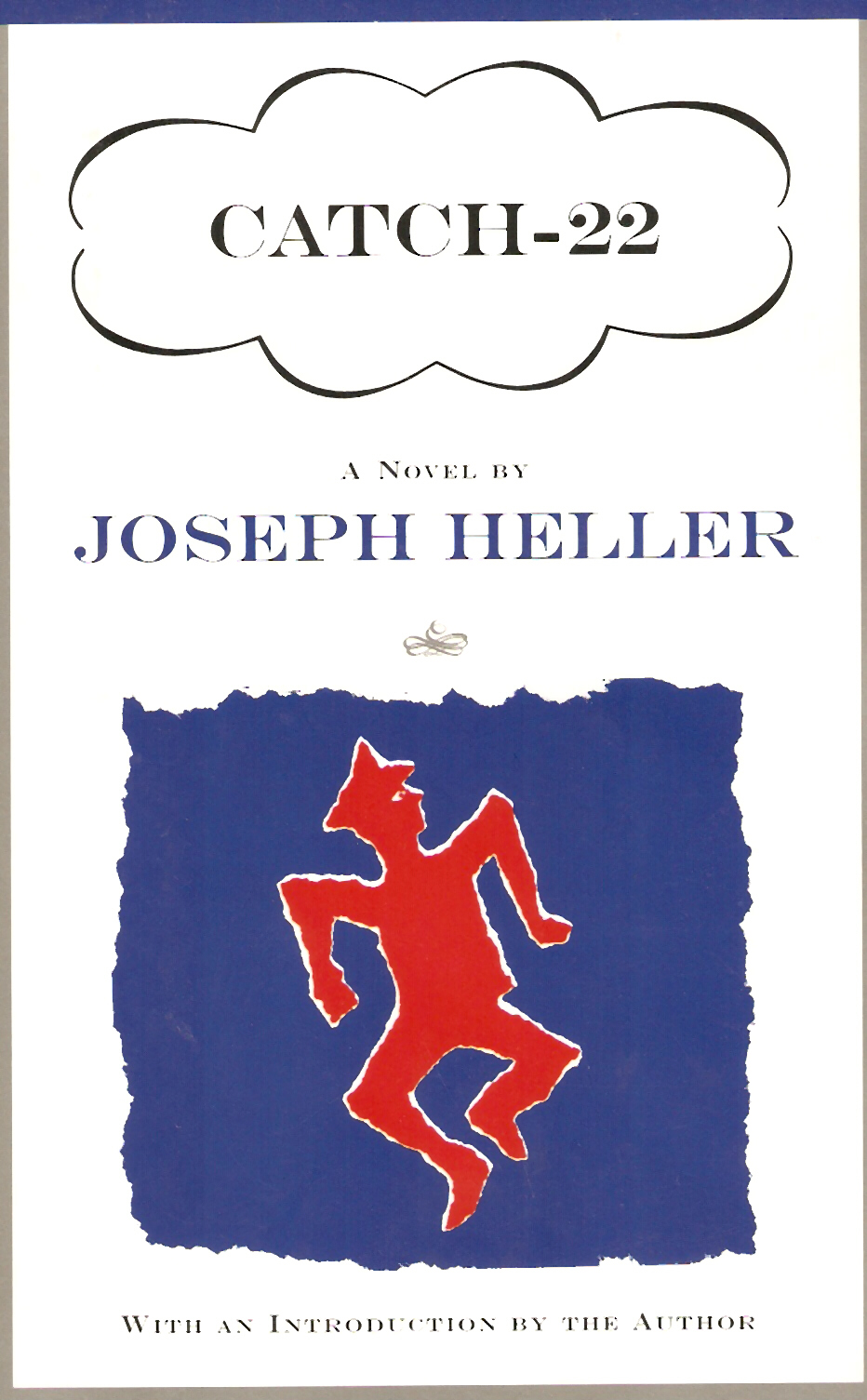
The first time I read Joseph Heller's Catch-22, I was very much with Yossarian, butting heads with the military/industrial establishment.  But the last time I read it, I was with Orr and no longer with Yossarian until the end of the novel, when he realizes that he had it wrong all along.  That his buddy, the laid-back Orr, had it right.  That the only way to deal with the duality of war was to step out of it and to make a separate peace.

The first time I read Ken Kesey's One Flew Over the Cuckoo's Nest, I was with McMurphy, bucking against the totalitarian Nurse Ratchet and the bureaucracy of the establishment.  But the last time I read the novel, I was with Chief Broom, the big Indian, who escaped and made a separate peace with the world.

The line containing "a separate peace" in Hemingway's A Farewell to Arms (where Henry escapes from the madness of World War I by going to Switzerland) was the source of the title of John Knowles' 1959 coming of age novel,  A Separate Peace (in which peace is finally achieved through forgiveness).

Sunday, February 27, 2011

Sunday's Smattering of Books Recently Read

The trinity in literature seems to be everywhere, a human universal inherited from the ancients.  We usually quote Emerson, as here, regarding this, and we delight in discovering such trinities as the furies in literary works, old and new.

Body, mind, and spirit.  Child, adult, and parent.  Id, ego, and superego.  A tool of interpretation with many variations, many parallels.


Peter Matthiessen, on page 41 of The Snow Leopard (Penguin Classics): "One "I" feels like an observer of this man who lies here in this sleeping bag in Asian mountains; another "I" is thinking about Alex; a third is the tired man who tries to sleep." Matthiessen tells the same tale three ways in his Pulitzer-winning Shadow Country (Modern Library Paperbacks), divided into three parts but all are one.


Robert Penn Warren showed the three "I" viewpoints in different ways in his greatest novel All the King's Men, as in this passage:
"It was like the second when you come late at night and see the yellow envelope of the telegram sticking out from under your door and you can lean and pick it up, but don't open it yet, not for a second. While you stand there in the hall, with the envelope in your hand, you feel there's an eye on you, a great big eye looking straight at you from miles and dark and through walls and houses and through your coat and vest and hide and sees you huddle up way inside, in the dark which is you, inside yourself, like a clammy, sad little foetus you carry around inside yourself. The eye knows what's in the envelope, and it is watching you to see you when you open it and know, too. But the clammy, sad little foetus which is you way down in the dark which is you too lifts up its sad little face and its eyes are blind, and it shivers cold inside you for it doesn't want to know what is in that envelope. It wants to lie in the dark and not know, and be warm in its not-knowing."
"The end of man is knowledge, but there is one thing he can't know. He can't know whether knowledge will save him or kill him. He will be killed, all right, but he can't know whether he is killed because of the knowledge which he has got or because of the knowledge which he hasn't got and which if he had it, would save him for another time. There's the cold in your stomach, but you open the envelope, you have to open the envelope, for the end of man is to know."
When we read a novel and identify with the protagonist and feel the emotions of the novel, we do so with one "I."  When we observe the protagonist, reflecting on the novel, interpreting its meaning, we do so with a different "I."
---------------------


The Lust for Blood: Why We Are Fascinated by Death, Murder, Horror, and Violence by Jeffrey A. Kottler (2011), 310 pages, including notes, bibliography, and index.


Jeffrey A. Kottler, PHD, "is a practicing psychologist, professor of counseling at California State University, Fullerton, and the author of more than seventy-five books, including the New York Times bestseller, The Last Victim: A True-Life Journey into the Mind of the Serial Killer."


Too often less of an argument than a survey of the way our culture is entertained by violence, The Lust For Blood is good but for my taste a bit too windy and too circumspect (as if to go easy on the pop, soundbite audience) to forcefully answer the question that the subtitle poses.  Dr. Kottler concludes:


"It is indeed the fear of death, the need for stimulation, and instinctual aggression that are at the core of our fascination with violence. There may come a day when human beings no longer require such stimulation in excise of our demons and purge ourselves of hostility. In the meantime, we live in the prisons of our own making, defined by our personal codes of honor and morality, as well as the choices we make for how we entertain ourselves."


I like what he says, but of course the need for stimulation and escape is also caused by repression, the denial of death.


Such entertainments as Reservoir Dogs and The Wild Bunch are briefly discussed. When, in the sub-chapter discussing these two, Cormac McCarthy gets mentioned, it is not Blood Meridian that gets quoted, but instead The Road.  And Dr. Kottler too separates the "I" of the observer from the "I" of the vicarious protagonist:


"Sam Peckinpah, who laid the groundwork for the violence in cinema of his generation, heartily agrees with Tarantino. In his films Wild Bunch and Straw Dogs, the public outcry only fed greater interest. Audiences appeared to clamor for the privilege of paying money to be horrified. Peckinpah claimed his films were actually antiviolent since they portray human behavior at its most base, primitive, and awful. 'And yet there's a certain response that you get from it, an excitement, because we're all violent people, we have violence within us."


"As previously mentioned, there is also a control element to the experience of viewing such films. You have the power at almost any moment to moderate the level of arousal you are feeling. If you become too terrified by what is happening on the screen, you always have the option to remind yourself that it is only a movie. Look at your watch. Close your eyes. Sneak a peek at your phone. Stretch. Reorient yourself. It's not real. It's not happening to me."


"If, on the other hand, you are feeling bored and disengaged from the film and want to ratchet up the excitement, then you can pretend that it is real. Jump in with both feet. Imagine that it's you who is running, hiding, or fighting. What would you do in this predicament?"


"This happened to me recently while attending a horrifying and disturbing movie about the end of the world as we know it. I think at one point I started to shut down because I was so freaked out. I kept looking at my watch and yawning. I started thinking about the set design and the camera angles, admiring the acting, wondering about how the special effects were designed. I was in perfect control--or so I thought at the time."


"But with an hour left to go, feeling restless and bored, I thought, What the hell, and slipped back into the narrative without my seatbelt attached. The film became so real for me that when the lights came back on, I was still there. I couldn't stop crying and couldn't even explain to my son why I was so upset."


"The film was The Road , based on Cormac McCarthy's story about a father's legacy to his son in a post apocalyptic world. I couldn't stop thinking about what I would do in such circumstances, what I would do to survive and protect my own family against marauding killers. And I couldn't stop crying because, for me, even a week later, the movie hadn't yet ended; I was still living it."


"Did I get my money's worth from an entertainment experience that still haunts me and invades my dreams and fantasies? You betcha. But I also lost control and I'm still paying for it."
_________


Lately I've been preoccupied with Stephen Greenleaf novels.  I began back at his first novel, Grave Error, and studied all of his novels straight through again.  I read them mostly with my observer eye this time, noting the nuances, the language, the little things, and recalling my first experiences of immersing myself into these novels, one by one, gladly forking over hardcover prices as soon as they appeared.  Greenleaf was a stylist too, with a wonderful sense of humor.


Stephen Greenleaf said (in the interview at this link) that his first novel was as much like those of Ross MacDonald as he could get it ("I'm surprised he didn't sue me.").  His narrator was mostly impersonal consciousness making its way into the case at hand, with no ego to get in the way of observing others.  As the novels progress, Greenleaf's protagonist/first-person narrator develops more and more of his own identity and personal motivations.  The great attraction of these novels (for me, at least) was his civilized voice.  Unlike so many private eyes, he wasn't a self-interested capitalist, nor a macho tough guy, nor a Sherlockian puzzle solver.  He was a seeker, a blue-collar social critic, reflective, introspective, and humble.

A lawyer himself, Greenleaf mostly made fun of lawyers in these books.  Tanner points out an occasional exception, including an old friend he goes to see in Past Tense.  The lawyer's office had been totally redecorated since the last time Tanner was there, with everything now in the western motif.  Tanner asks his friend, why the change?

"Cormac McCarthy," his friend says.  Tanner says that his friend acted surprised that he even knew who McCarthy was.

I had to laugh out loud when I first read that passage, back when Past Tense came out in 1998.  That same year McCarthy came out with Cities of the Plain.  McCarthy had won the National Book Award but was still a relatively unknown recluse back then--except to a core of loyal readers.  I remember going online to the Cormac McCarthy Society Forum and posting that excerpt there.

Stephen Greenleaf's books were always a special treat for this reader.  Highly intelligent and written in a sparkling style, they were always well reviewed as such.  But they didn't sell well.  Greenleaf tried different things and different publishers, but finally after  sixteen novels (fourteen Tanner novels and two stand alones), Greenleaf reluctantly quit writing and went back to lawyering.  He still doesn't even have his own wikipedia page.

Forgotten?  Not by his core of loyal readers, and good gosh, we miss him.  In his last novel, Ellipsis, he said goodbye to his readers with a satire on the publishing industry--before his own ellipsis.  This novel is written with his usual humor and asides and it also includes some special little things that you have to read very closely to catch.  I think I'll devote a Friday's Forgotten Book blog to it soon.

Friday, February 25, 2011

Friday's Forgotten Book: Glendon Swarthout's SKELETONS

Glendon Swarthout's SKELETONS, Double Day & Co, Garden City, New York, 1979.  This was the first and last adult mystery by Swarthout, who had already written The Shootist, Where The Boys Are, They Came To Cordura, and other fine novels.

I read it in first edition hardcover and laughed and marveled at Swarthout's quirky plot twists and word play.  It seems a bit dated now, but only because many of the things in here have been copied by others.  For instance, I believe that it was Swarthout who in this novel first coined the phrase "a pregnant pause," which has since entered common vernacular and which Wikipedia now uses to describes the comic pauses of comedians Victor Borge, Jack Benny, and Johnny Carson, among others.
Below is the epigraph from the first edition, a stylized quote from William Faulkner:
    The novel is a mystery wrapped in a kooky soap opera mixing well-researched historical western lore with madcap twists and turns, time out of time.  The protagonist is an author of children's novels trying to win back his ex-wife by solving the murder of her second husband.

It was optioned for a movie, to be directed by Wes Craven, but the deal fell through and the rights are now the property of the Swarthout estate.  Here's the opening of the novel with a couple of the finer paperback covers once advertising its motifs of skeletal time. 

I love GOOD and hate EVIL.
One thing I get a bang out of is reading aloud to a roomful of middle-aged children, ten to fourteen. I need to see how they react. What makes them laugh or cry, what grabs and engrosses them.
I was about to read a few pages, but first I had to set the stage.

“How many of you have flown?” I asked. Of the seventeen in the room, sixteen raised hands. Not surprising in New York. “Okay,” I said. “Now, how many have ever seen a fly on a plane?” Two raised hands, a few made faces. “Well, probably most of you have, and never thought about it. Next time you fly, notice. Usually you’ll see a fly or two hanging around the galley, where the stewardesses prepare meals. And why do flies fly? Why, because they enjoy travel, just as you do. And think of it--all a fly has to do is look at a schedule, decide where he’d like to go, pick his flight, fly to that gate, buzz aboard, and away he goes. No X-ray, no hand-luggage inspection. Free. And first-class, too, because the food and booze are better.
The phone rang.
“Jimmie?”
I went weak. Tyler Vaught.
“Wrong number,” I said.
I hung up on her, resumed. “Excuse me, kids, just my ex-wife. Where were we? Oh yes. I suppose most of you have seen JFK. Well, the next time you go out there, go to the TWA terminal, stand in the center of the big room, and look up near the ceiling, in the northeast corner. If you have good eyes, you’ll--“
The phone rang.
“Jimmie, this is Tyler.”
“I know.”
“Max is dead.”
A pregnant pause.
“Well?” she said.
“Well what?”
“Say something.”
“It couldn’t happen to a nicer guy.”
“You bastard.”
“Tyler, what am I supposed to do? Fall apart? So the sonofabitch is dead. Good night.”
“No, wait. He was killed by a hit-and-run driver. In Harding.”
“Harding? What in hell was he doing in New Mexico?”
“Well, it’s a long story. But one night I happened to tell him about Harding--you know, my grandfathers, the gunfight, the trials, 1910, 1916, and--“
“Oh no. Not that again.”
“And he got very excited. You know Max. He thought there might be a book in it. So the next day he flew out there. That was four days ago. Now he’s dead.”
“You’re breaking my heart.”
“Jimmie, why I called. His body’s being flown in from El Paso tomorrow. Someone in the family must sign for it--airline regulations--or somebody authorized by the family, and turn it over to the mortuary. Well, his dear old parents live in the Bronx and they’re on their knees--Max was an only child. So they’ve authorized me to meet the body and sign for it tomorrow afternoon and Jimmie, I don’t think I can do it. Alone. Jimmie, will you go with me?”
“Hit-and-run, huh? Sorry I wasn’t the driver.”
“Please.”
“I hope they total his coffin the way they total my luggage.”
“Jimmie, I need you. I can’t--“
Adios, Tyler.”

I hung up on her again and readdressed my fidgety audience. “Where were we? Oh yes. Up near the TWA ceiling you’ll see a crowd of flies. Well, they’re the jet set, the pro international travelers--TWA goes everywhere. This crowd hangs around between flights and exchanges information on the best airlines and the best hotels and so on and the most-traveled of them all is Frisby. Frisby is a really worldly fly. He’s just returned from Italy, is recovering from jet lag, and thinking about having a look at Africa next. There’s a midnight departure from Kennedy to Nairobi via London. And as our story begins-- the pages I’m going to read to you--Frisby’s asking his friends about visas and inoculations and safaris and--“
Suddenly I didn’t feel like reading, didn’t need a roomful of kids. Tyler would call again, she never quit, and I wanted to be alone to think of different ways to say no when she did.
“Bug off, you little buggers,” I said to them. “A man’s dead and I’m not in the mood. So get lost and good-bye.”
They disappeared.
Imaginary children of course. I wish I were happily married, with my own progeny to read to, but alas, I probably never will be. Or have my own progeny. I live in an apartment on East Seventy-third, between Fifth and Madison.

______________

This is a tag-along to Patti's Friday's Forgotten Book Series to be found at this link.

Wednesday, February 23, 2011

Let Us Talk Calmly About Violence

class warfare: aggravated class conflict.  Roundly condemned by many a politician who actually supports it, as long as it's being waged from the top down. --Norman Solomon, The Politician's Dictionary of Buzzwords,

There's a new book out on the violence of 1877, which unfortunately I do not have, so instead I'll tell you about Robert V. Bruce's magnificently comprehensive but little known gem entitled: 1877: Year of Violence.

Self-interested competition in the free market is a good thing as a whole, keeping prices low while at a level to still encourage their manufacture.  As in the game of Monopoly, however, when big businesses are allowed to squeeze out the smaller businesses through monopolies and cabels, the game continues until only one is left, thus collapsing the game for everyone, as monopoly money converts once again to the paper that it is and loses all value.

The government's role should be to keep the game going by keeping the playing field level.  Power corrupts and the powers of the economy need to stay separate lest they become corrupted.  Just as the federal separation of government power is necessary, the separation of economic power is essential.  Unfortunately government now allows the de-facto collusion of price fixing and monopolies and other manipulations while increasingly preventing the collective bargaining of labor and consumers. 

Adam Smith warned of the tendency of big business to conspire to manipulate the market and artificially raise prices while squeezing out the small businessman and the people who work for them, that a true lassez-faire economy "would quickly become a conspiracy of businesses and industry against consumers, with the former scheming to influence politics and legislation."

This is happening again.  The corrupt are too powerful to stop.  They have again made lassez-faire principles into a cause, a false immortality project.  The violence, when it arrives, will again come from above rather than below, from the strike breakers rather than the strikers.  Because the true believers, in the Eric Hoffer sense, are on their side.  We learn from history that people seldom learn from history.

Wednesday's Western: Alan LeMay's THE SEARCHERS


It would not be accurate to say that I'm an expert on the John Ford western, The Searchers, but I am very well read in the critical literature that has discussed it as well as the Alan LeMay novel upon which it is based.  Still, books related to both the movie and the book continue to appear and often surprise me.

There is a slight difference in tint between the 1954 first edition dustjacket and that of the Sears Bookclub Edition.  The dustjacket is usually described as mustard yellow or mustard brown.  The words at the bottom of the dustjacket front are from LeMay's epigraph.  The book first appeared abridged and serialized in The Saturday Evening Post under the title, "The Avenging Texans."

My annotated list of peripherals and references for THE SEARCHERS is here.


A good row of pictures of the movie cast is here.


The source of this picture of the mug, given by John Wayne to other members of the cast and crew back in 1956, is at the excellent "50 Westerns of the 50s" blog which is here.

The movie Ethan Edward's doubting "That'll be the day," by the way, inspired Buddy Holly to write the song by that name, and not the other way around.  It was not a commonly used catch phrase until after both the movie and the song appeared.  It has now passed out of vogue, although Carla Jean Moss, the wife of Cormac McCarthy's protagonist, used it in No Country for Old Men, published in 2005 but set in 1980.


Alan LeMay wrote a number of other westerns prior to The Searchers, but none of such high historical and literary quality.  The bookclub insert coupled it with Daphne Du Maurier's Mary Anne: A Novel as its two main selections.  The four-page synopsis gives away a lot of the ending of the book:
"What Mart and Amos couldn't know, however, was that Debbie, when at last they faced her, would prefer death to freedom.  For the girl they found at trail's end was no longer the child of memories, but a matured, defiant beauty, reared by the tribe as one of their own.  She was even, according to tribal custom, soon to be wed to a young brave.  To Debbie, the strangers were blood enemies and she turned on them with bitter fury.  In that climactic moment, Mart and Amos had to make a decision that could mean life or death for the three of them."


Of course, the ending was greatly changed and made more politically correct in the movie, and while I like it both ways, I greatly prefer the more historically accurate version in the book.  It is a documented fact that almost all captives of Native American nations, later given the choice to live red or white, chose to return to the red way of living.  Forcibly taken back, most of them ran off to rejoin their red families again at the first opportunity.