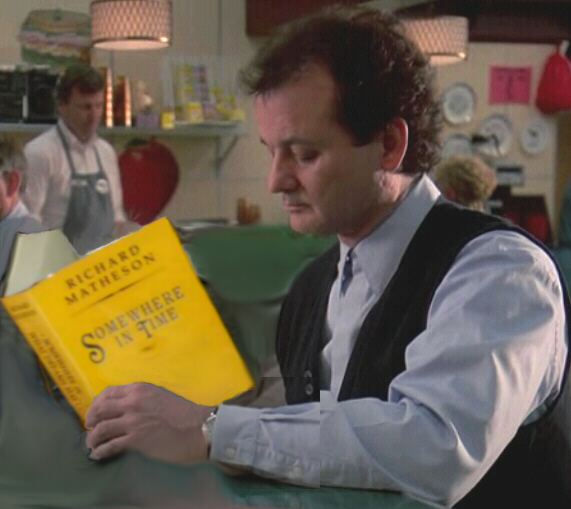
Well, it's Groundhog Day. Again. The earworms of the day are the soundtracks from the movies Groundhog Day and Somewhere In Time, particularly the Rachmaninoff 18th Variation from Rhapsody on a Theme of Paganini. When Bill Murray's character, Phil, decides to improve himself, among other things he does is to take piano lessons, and this is the song he wants to learn.
Which makes you think he has seen the movie version of Somewhere In Time.
What a lovely theme it is!
Murray (as Phil) renders a jazz rendition on the George Fenton soundtrack, along with songs by Nat King Cole, Delbert McClinton, Ray Charles, and others. Every morning, he awakens to Sonny and Cher's "I Got You Babe."
First of all, some warnings: this is not a review; this is an analysis. If you have not yet read this book, go to Largehearted Boy, link, see the author's soundtrack for the novel, and click on the links to reviews and interviews at the bottom.
And no matter what some other reviewers say, this is not a simple YA novel; it is not even a simple detective story about a search for a missing child; it is noir and a literary look at the darker side of the human condition. When you look into the abyss, it looks back at you and that should make you uncomfortable.
I passed on this book when it came out last year, though the initial reviews were good. Later, after it garnered so many outstanding reviews and award considerations, I earmarked it for reading in October, as a part of my Halloween horrorfest alongside Thomas H. Cook's Red Leaves and Stephen Dobyns' The Church of Dead Girls. I didn't get to it then, and Thanksgiving and the holiday season soon put me into a different reading paradigm.
I read it in January. The work I found myself comparing it to is Nanci Kincaid's marvelous As Hot As It Was You Ought To Thank Me, link, which I reviewed last year. Both novels are narrated by children on the cusp. Both novels involve a child and an adult who vanish mysteriously on the same day, inviting the worst speculations from the community. Both novels are adult and literary and psychological with insightful allusions and Edenic metaphorical symbols.
There are more similarities.
Both novels feature, at one point, a physical sexual situation between an adult and a child. Both authors risked melodrama for the sake of symbol by casting these respective adults as former saviors of their victims. These are cautionary scenes, to be sure, but graphic enough to be alarming and I think that both novels should have been edited better in this one regard. A few oblique nuances would have been enough. Heck, I think they give far too many sensational details on the six o'clock news too, any day of the week.
I also happen to prefer literary noir to graphic noir. That's me, but maybe not you.
Anyway, narrator Lizzie Hood and Evie Verver are thirteen-year-old best friends and neighbors. They're in flux, a state of change, moving between childhood and adulthood--doppelgangers, light and dark. Lizzie Hood is the more diffusely spiritual and virginal one, while Evie is an incarnation of Eve, the more carnal and darkly tempted, the one destined to fall.
The opening chapters are beautifully written, full of literary nuance and symbolic images that almost take your breath away. The likely suspects appear and possible plot threads are foreshadowed, some of them red herrings. The garden hose with its snout, the forked tongue, the blood dripping--sexual symbolism is everywhere. It is all too much for a thirteen-year-old girl to bear, and the author beautifully conveys this sense of being overwhelmed.
As the lush language and nuance drop away, you miss them, but then the plot thickens and it draws you in, convinced by then that this author must know where she's going and it probably won't be the usually cliched places.
The snake in the garden is Mr. Shaw, who knows that he's a snake, who can't help being a snake because that's what he is. Eve's perfect family falls from paradise because of her temptation. In her innocence, she gives herself to the snake, though we know that she is much too young to know what she is doing. Dark? Hell yes, it's dark.
Evie's sister Dusty appears as a Lilith character with an implied, suppressed sexual desire for their father that is Freudian--or perhaps super-Freudian. There is a twinning of father figures and daughter figures. This works on more than one level and makes much of Lizzie's early foreshadowing clearer, though you can take it or leave it depending on your own inclinations.
What happens is what always happens and continues to happen in life as well as myth. The snake self-destructs, but there are other snakes everywhere. Evie falls, losing innocence but gaining knowledge. Lizzie and Evie, once bound, now separate and hopefully move toward autonomy and adulthood.
The novel works on its various levels, as a mystery noir, as an Edenic parable, as a coming-of-age tale of olden days. Over at Largehearted Boy's blog, the author says that her first title for the novel was Nightswimming, which would have been suggestive of what lies beneath the surface here, the psychological rationalizations and projections.
Given the first edition dustjacket art and my interpretation of the novel, perhaps that would be the better title.
Native Kentuckian George Clooney was four years old when Kaui King, a son of Native Dancer destined to turn gray as he matured, won the Kentucky Derby in 1965.
Now a bit gray himself, Clooney can still run. In The Descendants, after he discovers that his wife may have been cheating on him, Clooney makes an emotional run to his neighbor's house, where he is going to try to either verify or discredit what his daughter has told him. This running scene is not in the book, though author Kaui Hart Hemmings achieves the same effect, with equal understatement and humor.
As Clooney's character, Matthew King, awakens to the truth, he also begins to awaken or reawaken to the nature of love and responsibility. It is a fine book and a fine movie, one in which the author was cast as King's secretary.
What we talk about when we talk about love depends upon our personal experience. Those Ayn Rand psychopaths incapable of love think that all lovers are simply faking it or else stupidly confusing love with pseudo-sentimentality and desire. Young love is often possessive love, an extension of the ego. Mature love is unconditional, as Shakespeare wrote of it in the sonnets, an unchanging love which does not alter when alteration is found.
Matthew King's run in the movie is in character, showing a man who has let himself go in important ways, a man who needs to catch up to himself and rediscover what is important in life. George Clooney plays it beautifully, but I doubt if Clooney himself is in such sad shape as some critics have suggested.
Even us old guys can run a bit, some of us. And some of us have learned how to love.
The old women exists in the young one at least as a potential, and the young girl exists in the older, wiser woman. The child is the mother of the woman. All present in this visage.
The image of Zola Budd once flashed across the television screens of our minds, running barefoot, kitteny yet intense. Now she's older and wiser, yet I cannot read about her nor look at recent pictures of her without seeing the young girl there too.
We disagreed with her country's politics, we found her father authoritarian or despotic, but we didn't have it in us to think badly of kitteny Zola, who said she just wanted to run, without regard to money or medals.
In 1984, America's Olympic dream finished up the track after Zola's accidental clipping of heels with Mary Decker. The race is a slow motion replay, still repeating over and over, frozen forever in eternity.
Do we remember the winner? Heck, no. We only remember the tragedy hyped and suspended there, the possibly errant course of history, haunted by the lost potentials of the moment.
The eidetic imagery that appeared in the movie Run Lola Run also reminds me of Zola Budd. We pull for Lola as we once rooted for Zola, even though her family and love interest are flawed, involved with bad things. In the movie, Lola is given three shots at redemption for them.
Possibilities stretch out in all directions, but Lola learns to reflect on her previous errors in a world in which people do their best when kind, who learn gratitude through reflection toward empathy.
We can't control chance. What free will we have is really a free won't, as David Eagleman says. We can choose to react to situations with empathy instead of ego, to choose mercy over revenge. We can choose to be kind.
At the end of Run Zola Run, the immediate crisis is resolved, but things are still potentially dire. Her boyfriend is still a mule for the drug dealers, who are still in business. Just as at the end of It's A Wonderful Life, Mr. Potter still has the stolen money and he still has the upper hand.
This is the way of the world. We can't control the world, we can only control how we respond to it. We would hope to see that Lola talks her boyfriend into getting an honest job, and it's possible, but that isn't what this movie is about. Like Groundhog Day, Run Lola Run is about the choices we make every day.
Politics has never been funnier than in the current Republican primary. Adding to the hilarity, for me, is the Jon Stewart and Stephen Colbert stuff plus my tandem reading of Thomas Frank's PITY THE BILLIONAIRE and Jason Heller's TAFT: 2012.
I kid you not, in TAFT: 2012, President Taft disappears the day Woodrow Wilson takes office and reappears in the fall of 2011 and enters the Republican primary.
It is a semi-epistolary novel, full of memos and dispatches that are fun to read, given Taft's positions on trusts and foreign policy and the humorous juxtapostions. I had to go on line and look up Taft's history to see how much was genuine and I was amazed.
It is both funny and sad, but you might as well laugh.
In case you haven't heard, Cormac McCarthy sold his new screenplay, The Counselor, to the folks who brought us The Road and Tree of Life.
They're looking for financing now, but the details about the script so far indicate that it is to be another drug war film involving a lawyer, with two women in strong supporting roles.
I finally saw THE ROAD. They did a bland job of it. Robert Duvall is fine actor, but they should have left McCarthy's own dialog in the film. Instead, they paraphrased everything and it came out not only bland but pointless compared to the novel.
When Eli says that we'll all be better off when everyone's gone, the wonderful comic irony of the line is something you wouldn't think would be cut out of the movie. But it was.
In the book, the man and boy have very little. They have not yet come upon the cache of canned goods. They meet Eli who is more spiritual, funny, and threadbare than the Eli in the movie by far. They argue over whether they should give him any food or not. They finally decide on the reflective, human side and give him food and a blanket.
Then they are rewarded by karma or by God or by their own sub-consciousness. They find the cache.
The movie reverses the plot and ruins any such interpretation of the movie. And that isn't the only thing they got wrong.
I read the novel before it was published. My review of it then can still be read at Amazon--the spotlight review there--and it is the book that will linger forever in my mind.
 Waterwalk: A Passage of Ghosts by Steven Faulkner. Kent Craven reviews it at this link. Sounds like my kind of book.
 Democracy Incorporated: Managed Democracy and the Specter of Inverted Totalitarianism by Sheldon S. Wolin. Recommended by Chris Hedges on C-Span.
Norman O. Brown's Life Against Death: The Psychoanalytical Meaning of History. Been meaning to read this one for years.
Shawn Green's The Way of Baseball: Finding Stillness At 95 MPH. A transcendental fastball.
I have but have not yet read the uncorrected galleys of John Burdett's VULTURE PEAK and Geoff Dyer's ZONA. Burdett's series, always good, is continued.
Dyer is also the author of the beautifully written jazz memoir But Beautiful, the crazy brilliant D. H. Lawrence conjuring, Out of Sheer Rage, and other books I've quoted in this blog.
The subject of ZONA: A BOOK ABOUT A FILM ABOUT A JOURNEY TO A ROOM is the Andrei Tarkovsky film, Stalker, which I haven't seen yet but need to rent.
Possible tandem reads: Allison Krauss's A Man Walks Into A Room or Emma Donoghue's Room: A Novel. Perhaps even The Enormous Room by E. E. Cummings. Plato's cave, maybe.
We'll see.
Meanwhile, I've been having fun reading all of the new books on consciousness, almost all of them written by well-qualified brain scientists. Besides the several I've read and listed on the best books list, I'm now reading Nicholas Humphrey's SOUL DUST: THE MAGIC OF CONSCIOUSNESS.
If I had to recommend only one of them, it would be David Eagleman's INCOGNITO: THE SECRET LIVES OF THE BRAIN. This book, along with my other reading, has shored up the way I look at free will (or free won't), and Eagleman has introduced me to several concepts I might have read somewhere but never took seriously before, such as "the Ulysses contract."
Free will seems to depend upon the circuitry in the prefrontal cortex, which is not yet developed in teenagers and never develops at all in some people.