This is a light comic mystery with poetic undertones. If you've tried to read others by this author earlier in the series and laid them aside, go back and start with this one. If you're completely new to the rich variety of Stephen Dobyns' novels and poetry, you might also want to start here.
This is a continuation of the Charlie Bradshaw/Saratoga private eye mysteries, but the narrator here is Victor Plotz, who often works for Bradshaw as Angel Martin worked for Jim Rockford in The Rockford Files. Like Angel, Plotz is no angel, but he's older, smarter, and funnier.
I always hear Plotz in something like a Rodney Dangerfield voice. Just listen:
"I got a girlfriend. Actually I got more than one but this is the main one, at least for now . . .Her name is Rosemary. . .She's fifty-one. She's big and plump and I call her the Queen of Softness. If you ask me, women only come into their prime after they hit fifty. Before that they've got too much bone and muscle: baby machines too easily distracted by what they have manufactured. They remind me of Japanese car companies, all style and no soul. Before menopause a woman can be a real nuisance, she's packed full of hidden agendas and most of them concern her kids.'
"But after fifty a woman's kids are usually grown up and she can turn herself over to pleasure. And they get soft at that age, almost spongy. It's the time when a woman gives up her figure and takes on a shape. Rosemary Larkin has a wonderful pear shape. No aerobics for her. Who wants a lady with a figure like a letter knife.'
"Rosemary has got this hot tub in her basement and we sit in it and play Elevator. I put my hands under her breasts--big white stocking-cap breasts with nipples like the eye of the cyclops who Kirk Douglas bumped off in that movie about Ulysses. I put my hands under Rosemary's breasts so I can feel their weight, their very consequence and magnitude, and Rosemary calls out, 'Eighth Floor!" and slowly I raise her breasts up out of the bubbling water. Then she calls out 'Fourth floor!' and slowly I lower them again. Then she calls 'Bargain Basement!' and we go down, down, down.'

THE GUARD is a dark comedy for adults, the best I've seen in a long time. Much of the humor is intellectual, you might say, but a lot of it is also slapstick, lower-grade stuff. I can't think of a movie to compare it to; it is that unique.
We saw it the day after I reviewed Adrian McKinty's COLD COLD GROUND, and the book had some of the same elements as the movie. Gangsters; drug violence; bribes and extortion; religious, racial, and gender prejudice; casual sexual relations; jibes at the Brits, at Dublin, at the corruption of policemen in general.
It may sound like the usual, but it isn't. Brendan Gleeson as Gerry Boyle is corrupt, but he is not conventionally corrupt. He lives within an existential code of his own.
My favorite scene is where Gleeson and the FBI agent are about to confront the drug smugglers. The FBI man says that he's sent for back-up, that they should wait for back-up, but Boyle knows that back-up won't be coming because the entire western coast of Ireland is on the take.
Like a lot of scenes in here, this one is underplayed, but you get it. It's just you and me, Boyle tells him. There will be no back-up. Colexico then provides a suitable spaghetti western soundtrack at this point in the movie.
The entire soundtrack is witty, quirky, surprising. They open the credits with John Denver's "Leaving On a Jet Plane," which makes you wonder if Boyle himself didn't come up with that one as he boards a plane on the way to a sequel.
I also especially loved a scene where the three main smugglers discuss philosophy and nothingness, all to comic effect. The overall acting was splendid and none too serious, as you can tell by listening to the backstory comments on the DVD--where writer/director John Michael McDonagh teams up with the actors.
I know they are having trouble finding an actor capable of playing Cormac McCarthy's Judge Holden for the movie of Blood Meridan. Maybe Gleeson could do it; he's big enough, with the right sense of humor.
We'll see.
What's love got to do with it? Plenty. My cup runneth over, and I'm grateful for the day.
Yeah, I know. Like almost every other holiday, this one is overly commercialized. Sales of candy, cards, jewelry and sexy lingerie depend on it.
Over at one of my favorite blogs, The Rap Sheet, J. Kingston Pierce provides links to Valentine's Day history, and over at Killer Covers, link, he gives us some noir book covers with kiss in the title.
But just as sex is much more than a kiss, and just as love is so much more than sex, the meaning of today for us is much more than randy sex, much more than an excuse to eat chocolate, much more than "sentimental movies and sappy songs."
Valentine's Day is yet another day of gratitude, a reminder that we need to stay mindful and grateful for our love this and every day. Every day is Thanksgiving, every day is Christmas, every day is New Year's Day, every day is Groundhog Day, every day is Valentine's Day, and it should be.
You need to look beyond the commercialism and materialism of these holidays to see what is real and eternal, to see what is really important in life.
Again this year, I'm posting Kenneth Fearing's funny verse, and I'll discuss the way I see it below:

All right, I may have lied to you and about you,
and made a few
pronouncements a bit too sweeping,
perhaps, and possibly
forgotten to tag the bases here or there.
And damned your extravagance,
and maligned your tastes,
and libeled your relatives,
and slandered a few of your friends.
O.K.
Nevertheless, come back.
Come home. I will agree to forget the statements
that you issued
so copiously to the neighbors and the press.
And you will forget that figment of your imagination,
the blonde from Detroit;
I will agree that your lady friend who lives above us
is not crazy, bats, nutty as they come,
but on the contrary rather bright,
And you will concede that poor old Steinberg
is neither a drunk, nor a swindler,
but simply a guy on the eccentric side,
trying to get along.
Because I forgive you, yet, for everything.
I forgive you for being beautiful and generous and wise.
I forgive you, to put it simply, for being alive,
and pardon you, in short, for being you.
Because tonight you are in my hair and eyes,
And every street light that our taxi passes shows me
you again, still you,
And because tonight all other nights are black,
all other hours are cold and far away,
and now, this minute, the stars
are very near and bright.
Come back. We will have a celebration to end all
celebrations.
We will invite the undertaker who lives beneath us,
and a couple of boys from the office,
and some other friends.
And Steinberg, who is off the wagon, and that insane
woman who lives upstairs, and a few reporters,
if anything should break.
_____
What's wrong with the way most Americans view love? Plenty.
Just as in the title of the verse above, most Americans assign "love" a monetary value. Materialists themselves in a material culture, they see material value in everything, and they bargain everything, tit for tat. Their love is conditional and hence temporary. Their material, superficial possessive love does not last, for they fail to see what is real but not material, they fail to appreciate what cannot be weighed and measured on a scale.
Their lovers are something they possess, trophy lovers, simply material things to collect and to be disposed of when they lose that glamor, that material value.
Lots of popularly acclaimed books professing to be love stories only deal with this form of possessive love, with juvenile ego trips rather than love itself, with the shallow and temporal rather than the eternal and deep. According to these materialistic authors, finding love is something like figuring out the most glamorous date available to take to the prom.
Such stories are often clever, witty, and sometimes fun to read, but they are also sad because these authors have not yet learned to see beyond the material. Their most "adult" stories are stuck in a juvenile mode. They can be verse but never poetry, because materialists do not yet believe in the transcendant where love resides.
THE COLD COLD GROUND is a brilliant new thriller/police procedural by Adrian McKinty, a multicultural writer of considerable experience and impeccable qualifications. Although Soho Press inexplicably passed on publishing it here in the United States, you can still buy it at Amazon (as I did), for less than $20 and it is well worth the expense and effort.
Set in Northern Ireland's Carrickfergus during the terrorism (or the Troubles as they are politely and routinely called), The Cold Cold Ground is a detective yarn spun against the backdrop of history. It is also a period piece bristling with the attitudes and artifacts of that time. For example, the narrator/detective protagonist describes the lady pathologist as looking like Samantha of Bewitched , certainly a generational reference, but young people will still get the idea.
A lot of the Irish slang was new to me, but the context was such that I had no difficulty in picking it up. It added rather than subtracted from the reading experience, so much easier than reading Peter Temple's Australian slang in his own equally brilliant but more widely known detective yarn, Truth (the winner of the 2010 Miles Franklin Literary Award for best novel).
The title of The Cold Cold Ground comes not from the Stephen Foster spiritual but from Tom Waits' song, quoted in an epigraph. A playlist of the music mentioned in the text includes Blondie, Juice Newton, and several others familiar to most Americans.
Secular Americans generally find it hard to relate to Ireland's Protestant/Catholic partisan divide. Readers of Lawrence Block's popular and savvy Scudder series will be familiar with his Irish gangsters, ex-patriots relocated to New York. The Cold Cold Ground will show you the other side of the coin in a very real way.
Do a search and you can find several other glowing international reviews of this novel, but my advice is to avoid spoilers and to let the novel surprise you with its delightful twists and turns. McKinty is a stylist and his protagonist often muses on the ironies and complexities of human existence. It is both beautiful and astonishingly well grounded in history.
Hard aground to the cold, cold ground.
You can listen to Charlotte Church's lovely "Carrickfergus" at this link. And the Celtic Woman version is here, link.
"The ultimate act of thirties usurpation is Ayn Rand's thousand-page 1957 novel, Atlas Shrugged. To its present-day fans, it is a work of amazing prescience, the story of the overregulating, liberty-smothering Obama administration told more than fifty years before it actually happened.'
"For me, it is the political flimflam of our times wrapped up in one big package: the manifesto of the deregulators and free marketeers who caused the economic disaster, embraced without a glimmer of awareness by the protest movement that the disaster stirred up.'
"The story of a group of business leaders fighting big-government oppression, Atlas Shrugged has been popular since it was first published, especially among egotistical fourteen-year-olds and among the sort of self-pitying mogul types who see themselves in the book's tycoon heroes. For free-market true believers, the tome is their very own Uncle Tom's Cabin, or, more accurately, their Caesar's Column.'
"With Barack Obama's inauguration in January of 2009, sales of Atlas Shrugged registered a remarkable uptick. Everyone could see that it was the novel for the era. The opinion page of the Wall Street Journal hailed it as the tale of our times foretold.
The influential blogger Michelle Malkin urged readers to emulate the book's entrepreneurial heroes. Officers of the Ayn Rand legacy organizations began appearing at Tea Party rallies, stoking the fires of discontent; protest signs started quoting famous lines from the novel; someone issued silver coins emblazoned with the name of the book's main character; and a movie based on the book was released to the great anticipation of the resurgent Right.'
"Rand fans heard the call to the colors. Among our characters, Rick Santelli and Mike Pompeo are both disciples. Paul Ryan suggested in 2009 that 'we are right now living in an Ayn Rand novel, metaphorically speaking."
Among the freshman class in Congress, the fandom burns brightly. Senator Ron Johnson of Wisconsin refers to Atlas Shrugged as his 'foundational book.' Representative David Schweikert of Arizona cites Atlas Shrugged as his favorite book, Representative Rick Crawford of Arkansas quotes Rand on his Twitter feed, and Senator Rand Paul describes Atlas Shrugged as a "must-read classic in the cause of liberty."


"And then, in a notorious passage, the narrator goes through all the other passenger cars on the train and tells us why each casualty-to-be deserves the fate that is coming to him or her. One of them, she points out, received government loans; another doesn't like businessmen; a third is married to a federal regulator; a fourth foolishly thinks she has a right to ride on a train even when she doesn't own the train in question. For each one of these subhumans, the sentence is death.'
"For a reader like me, Ayn Rand's almost total contempt for humanity is her most repugnant point. For the master spirits of our contemporary Right, though, I sometimes suspect that's the stuff that rings truest." Identification with the billionaire as a superior man, and deserved comeuppance for the humiliation and death of everyone else. "The game is finally up for the whiners of the world, they exult. . ."
This is the script of the Tea Party, of the Republican Party as it stands. It worships the God of the Market, a false idol, a laissez-faire utopia. "What they pine for is a system that can never exist, that has never existed, and that will never exist. And with every inch they bring us toward that ugly utopia, our society's deterioration accelerates."
"Inflexible dogmatism is, after sociopathic shrillness and fast trains, one of the great selling points of Atlas Shrugged. . .But the lastest Right doesn't so much simplify reality as idealize it. They're in a place where beliefs don't really have consequences, where premises are not to be checked, only repeated in a louder voice."
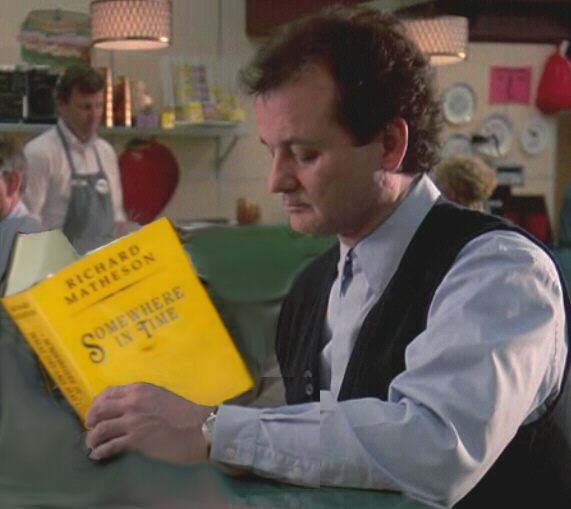
Well, it's Groundhog Day. Again. The earworms of the day are the soundtracks from the movies Groundhog Day and Somewhere In Time, particularly the Rachmaninoff 18th Variation from Rhapsody on a Theme of Paganini. When Bill Murray's character, Phil, decides to improve himself, among other things he does is to take piano lessons, and this is the song he wants to learn.
Which makes you think he has seen the movie version of Somewhere In Time.
What a lovely theme it is!
Murray (as Phil) renders a jazz rendition on the George Fenton soundtrack, along with songs by Nat King Cole, Delbert McClinton, Ray Charles, and others. Every morning, he awakens to Sonny and Cher's "I Got You Babe."
First of all, some warnings: this is not a review; this is an analysis. If you have not yet read this book, go to Largehearted Boy, link, see the author's soundtrack for the novel, and click on the links to reviews and interviews at the bottom.
And no matter what some other reviewers say, this is not a simple YA novel; it is not even a simple detective story about a search for a missing child; it is noir and a literary look at the darker side of the human condition. When you look into the abyss, it looks back at you and that should make you uncomfortable.
I passed on this book when it came out last year, though the initial reviews were good. Later, after it garnered so many outstanding reviews and award considerations, I earmarked it for reading in October, as a part of my Halloween horrorfest alongside Thomas H. Cook's Red Leaves and Stephen Dobyns' The Church of Dead Girls. I didn't get to it then, and Thanksgiving and the holiday season soon put me into a different reading paradigm.
I read it in January. The work I found myself comparing it to is Nanci Kincaid's marvelous As Hot As It Was You Ought To Thank Me, link, which I reviewed last year. Both novels are narrated by children on the cusp. Both novels involve a child and an adult who vanish mysteriously on the same day, inviting the worst speculations from the community. Both novels are adult and literary and psychological with insightful allusions and Edenic metaphorical symbols.
There are more similarities.
Both novels feature, at one point, a physical sexual situation between an adult and a child. Both authors risked melodrama for the sake of symbol by casting these respective adults as former saviors of their victims. These are cautionary scenes, to be sure, but graphic enough to be alarming and I think that both novels should have been edited better in this one regard. A few oblique nuances would have been enough. Heck, I think they give far too many sensational details on the six o'clock news too, any day of the week.
I also happen to prefer literary noir to graphic noir. That's me, but maybe not you.
Anyway, narrator Lizzie Hood and Evie Verver are thirteen-year-old best friends and neighbors. They're in flux, a state of change, moving between childhood and adulthood--doppelgangers, light and dark. Lizzie Hood is the more diffusely spiritual and virginal one, while Evie is an incarnation of Eve, the more carnal and darkly tempted, the one destined to fall.
The opening chapters are beautifully written, full of literary nuance and symbolic images that almost take your breath away. The likely suspects appear and possible plot threads are foreshadowed, some of them red herrings. The garden hose with its snout, the forked tongue, the blood dripping--sexual symbolism is everywhere. It is all too much for a thirteen-year-old girl to bear, and the author beautifully conveys this sense of being overwhelmed.
As the lush language and nuance drop away, you miss them, but then the plot thickens and it draws you in, convinced by then that this author must know where she's going and it probably won't be the usually cliched places.
The snake in the garden is Mr. Shaw, who knows that he's a snake, who can't help being a snake because that's what he is. Eve's perfect family falls from paradise because of her temptation. In her innocence, she gives herself to the snake, though we know that she is much too young to know what she is doing. Dark? Hell yes, it's dark.
Evie's sister Dusty appears as a Lilith character with an implied, suppressed sexual desire for their father that is Freudian--or perhaps super-Freudian. There is a twinning of father figures and daughter figures. This works on more than one level and makes much of Lizzie's early foreshadowing clearer, though you can take it or leave it depending on your own inclinations.
What happens is what always happens and continues to happen in life as well as myth. The snake self-destructs, but there are other snakes everywhere. Evie falls, losing innocence but gaining knowledge. Lizzie and Evie, once bound, now separate and hopefully move toward autonomy and adulthood.
The novel works on its various levels, as a mystery noir, as an Edenic parable, as a coming-of-age tale of olden days. Over at Largehearted Boy's blog, the author says that her first title for the novel was Nightswimming, which would have been suggestive of what lies beneath the surface here, the psychological rationalizations and projections.
Given the first edition dustjacket art and my interpretation of the novel, perhaps that would be the better title.