THE COLD COLD GROUND is a brilliant new thriller/police procedural by Adrian McKinty, a multicultural writer of considerable experience and impeccable qualifications. Although Soho Press inexplicably passed on publishing it here in the United States, you can still buy it at Amazon (as I did), for less than $20 and it is well worth the expense and effort.
Set in Northern Ireland's Carrickfergus during the terrorism (or the Troubles as they are politely and routinely called), The Cold Cold Ground is a detective yarn spun against the backdrop of history. It is also a period piece bristling with the attitudes and artifacts of that time. For example, the narrator/detective protagonist describes the lady pathologist as looking like Samantha of Bewitched , certainly a generational reference, but young people will still get the idea.
A lot of the Irish slang was new to me, but the context was such that I had no difficulty in picking it up. It added rather than subtracted from the reading experience, so much easier than reading Peter Temple's Australian slang in his own equally brilliant but more widely known detective yarn, Truth (the winner of the 2010 Miles Franklin Literary Award for best novel).
The title of The Cold Cold Ground comes not from the Stephen Foster spiritual but from Tom Waits' song, quoted in an epigraph. A playlist of the music mentioned in the text includes Blondie, Juice Newton, and several others familiar to most Americans.
Secular Americans generally find it hard to relate to Ireland's Protestant/Catholic partisan divide. Readers of Lawrence Block's popular and savvy Scudder series will be familiar with his Irish gangsters, ex-patriots relocated to New York. The Cold Cold Ground will show you the other side of the coin in a very real way.
Do a search and you can find several other glowing international reviews of this novel, but my advice is to avoid spoilers and to let the novel surprise you with its delightful twists and turns. McKinty is a stylist and his protagonist often muses on the ironies and complexities of human existence. It is both beautiful and astonishingly well grounded in history.
Hard aground to the cold, cold ground.
You can listen to Charlotte Church's lovely "Carrickfergus" at this link. And the Celtic Woman version is here, link.
"The ultimate act of thirties usurpation is Ayn Rand's thousand-page 1957 novel, Atlas Shrugged. To its present-day fans, it is a work of amazing prescience, the story of the overregulating, liberty-smothering Obama administration told more than fifty years before it actually happened.'
"For me, it is the political flimflam of our times wrapped up in one big package: the manifesto of the deregulators and free marketeers who caused the economic disaster, embraced without a glimmer of awareness by the protest movement that the disaster stirred up.'
"The story of a group of business leaders fighting big-government oppression, Atlas Shrugged has been popular since it was first published, especially among egotistical fourteen-year-olds and among the sort of self-pitying mogul types who see themselves in the book's tycoon heroes. For free-market true believers, the tome is their very own Uncle Tom's Cabin, or, more accurately, their Caesar's Column.'
"With Barack Obama's inauguration in January of 2009, sales of Atlas Shrugged registered a remarkable uptick. Everyone could see that it was the novel for the era. The opinion page of the Wall Street Journal hailed it as the tale of our times foretold.
The influential blogger Michelle Malkin urged readers to emulate the book's entrepreneurial heroes. Officers of the Ayn Rand legacy organizations began appearing at Tea Party rallies, stoking the fires of discontent; protest signs started quoting famous lines from the novel; someone issued silver coins emblazoned with the name of the book's main character; and a movie based on the book was released to the great anticipation of the resurgent Right.'
"Rand fans heard the call to the colors. Among our characters, Rick Santelli and Mike Pompeo are both disciples. Paul Ryan suggested in 2009 that 'we are right now living in an Ayn Rand novel, metaphorically speaking."
Among the freshman class in Congress, the fandom burns brightly. Senator Ron Johnson of Wisconsin refers to Atlas Shrugged as his 'foundational book.' Representative David Schweikert of Arizona cites Atlas Shrugged as his favorite book, Representative Rick Crawford of Arkansas quotes Rand on his Twitter feed, and Senator Rand Paul describes Atlas Shrugged as a "must-read classic in the cause of liberty."


"And then, in a notorious passage, the narrator goes through all the other passenger cars on the train and tells us why each casualty-to-be deserves the fate that is coming to him or her. One of them, she points out, received government loans; another doesn't like businessmen; a third is married to a federal regulator; a fourth foolishly thinks she has a right to ride on a train even when she doesn't own the train in question. For each one of these subhumans, the sentence is death.'
"For a reader like me, Ayn Rand's almost total contempt for humanity is her most repugnant point. For the master spirits of our contemporary Right, though, I sometimes suspect that's the stuff that rings truest." Identification with the billionaire as a superior man, and deserved comeuppance for the humiliation and death of everyone else. "The game is finally up for the whiners of the world, they exult. . ."
This is the script of the Tea Party, of the Republican Party as it stands. It worships the God of the Market, a false idol, a laissez-faire utopia. "What they pine for is a system that can never exist, that has never existed, and that will never exist. And with every inch they bring us toward that ugly utopia, our society's deterioration accelerates."
"Inflexible dogmatism is, after sociopathic shrillness and fast trains, one of the great selling points of Atlas Shrugged. . .But the lastest Right doesn't so much simplify reality as idealize it. They're in a place where beliefs don't really have consequences, where premises are not to be checked, only repeated in a louder voice."
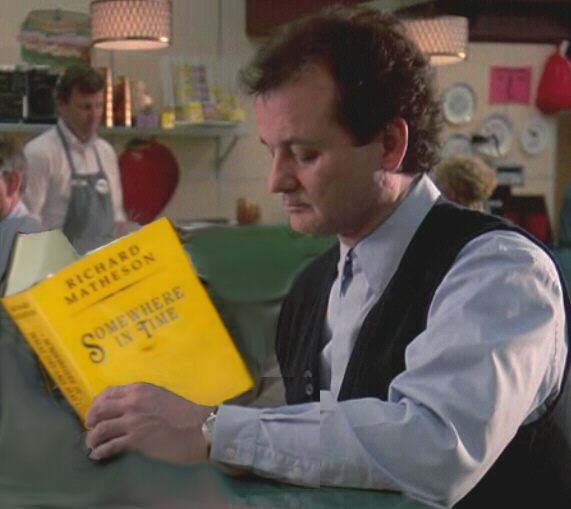
Well, it's Groundhog Day. Again. The earworms of the day are the soundtracks from the movies Groundhog Day and Somewhere In Time, particularly the Rachmaninoff 18th Variation from Rhapsody on a Theme of Paganini. When Bill Murray's character, Phil, decides to improve himself, among other things he does is to take piano lessons, and this is the song he wants to learn.
Which makes you think he has seen the movie version of Somewhere In Time.
What a lovely theme it is!
Murray (as Phil) renders a jazz rendition on the George Fenton soundtrack, along with songs by Nat King Cole, Delbert McClinton, Ray Charles, and others. Every morning, he awakens to Sonny and Cher's "I Got You Babe."
First of all, some warnings: this is not a review; this is an analysis. If you have not yet read this book, go to Largehearted Boy, link, see the author's soundtrack for the novel, and click on the links to reviews and interviews at the bottom.
And no matter what some other reviewers say, this is not a simple YA novel; it is not even a simple detective story about a search for a missing child; it is noir and a literary look at the darker side of the human condition. When you look into the abyss, it looks back at you and that should make you uncomfortable.
I passed on this book when it came out last year, though the initial reviews were good. Later, after it garnered so many outstanding reviews and award considerations, I earmarked it for reading in October, as a part of my Halloween horrorfest alongside Thomas H. Cook's Red Leaves and Stephen Dobyns' The Church of Dead Girls. I didn't get to it then, and Thanksgiving and the holiday season soon put me into a different reading paradigm.
I read it in January. The work I found myself comparing it to is Nanci Kincaid's marvelous As Hot As It Was You Ought To Thank Me, link, which I reviewed last year. Both novels are narrated by children on the cusp. Both novels involve a child and an adult who vanish mysteriously on the same day, inviting the worst speculations from the community. Both novels are adult and literary and psychological with insightful allusions and Edenic metaphorical symbols.
There are more similarities.
Both novels feature, at one point, a physical sexual situation between an adult and a child. Both authors risked melodrama for the sake of symbol by casting these respective adults as former saviors of their victims. These are cautionary scenes, to be sure, but graphic enough to be alarming and I think that both novels should have been edited better in this one regard. A few oblique nuances would have been enough. Heck, I think they give far too many sensational details on the six o'clock news too, any day of the week.
I also happen to prefer literary noir to graphic noir. That's me, but maybe not you.
Anyway, narrator Lizzie Hood and Evie Verver are thirteen-year-old best friends and neighbors. They're in flux, a state of change, moving between childhood and adulthood--doppelgangers, light and dark. Lizzie Hood is the more diffusely spiritual and virginal one, while Evie is an incarnation of Eve, the more carnal and darkly tempted, the one destined to fall.
The opening chapters are beautifully written, full of literary nuance and symbolic images that almost take your breath away. The likely suspects appear and possible plot threads are foreshadowed, some of them red herrings. The garden hose with its snout, the forked tongue, the blood dripping--sexual symbolism is everywhere. It is all too much for a thirteen-year-old girl to bear, and the author beautifully conveys this sense of being overwhelmed.
As the lush language and nuance drop away, you miss them, but then the plot thickens and it draws you in, convinced by then that this author must know where she's going and it probably won't be the usually cliched places.
The snake in the garden is Mr. Shaw, who knows that he's a snake, who can't help being a snake because that's what he is. Eve's perfect family falls from paradise because of her temptation. In her innocence, she gives herself to the snake, though we know that she is much too young to know what she is doing. Dark? Hell yes, it's dark.
Evie's sister Dusty appears as a Lilith character with an implied, suppressed sexual desire for their father that is Freudian--or perhaps super-Freudian. There is a twinning of father figures and daughter figures. This works on more than one level and makes much of Lizzie's early foreshadowing clearer, though you can take it or leave it depending on your own inclinations.
What happens is what always happens and continues to happen in life as well as myth. The snake self-destructs, but there are other snakes everywhere. Evie falls, losing innocence but gaining knowledge. Lizzie and Evie, once bound, now separate and hopefully move toward autonomy and adulthood.
The novel works on its various levels, as a mystery noir, as an Edenic parable, as a coming-of-age tale of olden days. Over at Largehearted Boy's blog, the author says that her first title for the novel was Nightswimming, which would have been suggestive of what lies beneath the surface here, the psychological rationalizations and projections.
Given the first edition dustjacket art and my interpretation of the novel, perhaps that would be the better title.
Native Kentuckian George Clooney was four years old when Kaui King, a son of Native Dancer destined to turn gray as he matured, won the Kentucky Derby in 1965.
Now a bit gray himself, Clooney can still run. In The Descendants, after he discovers that his wife may have been cheating on him, Clooney makes an emotional run to his neighbor's house, where he is going to try to either verify or discredit what his daughter has told him. This running scene is not in the book, though author Kaui Hart Hemmings achieves the same effect, with equal understatement and humor.
As Clooney's character, Matthew King, awakens to the truth, he also begins to awaken or reawaken to the nature of love and responsibility. It is a fine book and a fine movie, one in which the author was cast as King's secretary.
What we talk about when we talk about love depends upon our personal experience. Those Ayn Rand psychopaths incapable of love think that all lovers are simply faking it or else stupidly confusing love with pseudo-sentimentality and desire. Young love is often possessive love, an extension of the ego. Mature love is unconditional, as Shakespeare wrote of it in the sonnets, an unchanging love which does not alter when alteration is found.
Matthew King's run in the movie is in character, showing a man who has let himself go in important ways, a man who needs to catch up to himself and rediscover what is important in life. George Clooney plays it beautifully, but I doubt if Clooney himself is in such sad shape as some critics have suggested.
Even us old guys can run a bit, some of us. And some of us have learned how to love.
The old women exists in the young one at least as a potential, and the young girl exists in the older, wiser woman. The child is the mother of the woman. All present in this visage.
The image of Zola Budd once flashed across the television screens of our minds, running barefoot, kitteny yet intense. Now she's older and wiser, yet I cannot read about her nor look at recent pictures of her without seeing the young girl there too.
We disagreed with her country's politics, we found her father authoritarian or despotic, but we didn't have it in us to think badly of kitteny Zola, who said she just wanted to run, without regard to money or medals.
In 1984, America's Olympic dream finished up the track after Zola's accidental clipping of heels with Mary Decker. The race is a slow motion replay, still repeating over and over, frozen forever in eternity.
Do we remember the winner? Heck, no. We only remember the tragedy hyped and suspended there, the possibly errant course of history, haunted by the lost potentials of the moment.
The eidetic imagery that appeared in the movie Run Lola Run also reminds me of Zola Budd. We pull for Lola as we once rooted for Zola, even though her family and love interest are flawed, involved with bad things. In the movie, Lola is given three shots at redemption for them.
Possibilities stretch out in all directions, but Lola learns to reflect on her previous errors in a world in which people do their best when kind, who learn gratitude through reflection toward empathy.
We can't control chance. What free will we have is really a free won't, as David Eagleman says. We can choose to react to situations with empathy instead of ego, to choose mercy over revenge. We can choose to be kind.
At the end of Run Zola Run, the immediate crisis is resolved, but things are still potentially dire. Her boyfriend is still a mule for the drug dealers, who are still in business. Just as at the end of It's A Wonderful Life, Mr. Potter still has the stolen money and he still has the upper hand.
This is the way of the world. We can't control the world, we can only control how we respond to it. We would hope to see that Lola talks her boyfriend into getting an honest job, and it's possible, but that isn't what this movie is about. Like Groundhog Day, Run Lola Run is about the choices we make every day.
Politics has never been funnier than in the current Republican primary. Adding to the hilarity, for me, is the Jon Stewart and Stephen Colbert stuff plus my tandem reading of Thomas Frank's PITY THE BILLIONAIRE and Jason Heller's TAFT: 2012.
I kid you not, in TAFT: 2012, President Taft disappears the day Woodrow Wilson takes office and reappears in the fall of 2011 and enters the Republican primary.
It is a semi-epistolary novel, full of memos and dispatches that are fun to read, given Taft's positions on trusts and foreign policy and the humorous juxtapostions. I had to go on line and look up Taft's history to see how much was genuine and I was amazed.
It is both funny and sad, but you might as well laugh.