
 and Losing Moses on the Freeway: The 10 Commandments in America
 . I suspect that these two will last when the others are long out of print.
His two most recent books are Empire of Illusion: The End of Literacy and the Triumph of Spectacle
 and Death of the Liberal Class
 . At the end of his talk, he fielded questions from the audience. People wanted to know, What's to be done?
Chris Hedges wisely refused to take a stand on many things, said that he was simply an investigative journalist who had diagnosed the illness, not knowing a cure for the disease. He said that he was anti-authoritarian by nature, but not one to start or join causes.
Indeed. Liberals have no cause to join anyway. The only cause in American life left to attract true believers, in the Eric Hoffer sense, is the Tea Party. Initially manufactured by Fox News with the help of Rush Limbaugh, Glenn Beck, and other demagogues in the fold of the Super Rich, it has now grown to a formidable force. The main doctrine of the Tea Party is that laissez-faire capitalism is the American Way and should be fully implemented. True believers, looking for a cause to join, flock to their side. It's like Orwell's 1984, in that the ruling rich have thus created their own underground.

What's to be done? There's no stopping them now, and the hard lessons of history will have to be learned all over again. The Supreme Court may have sealed the new U. S. Plutocracy forever by recently decreeing that corporations were equal to citizens and that corporations might sponsor political candidates with unlimited funds. Rule by the rich--that's what it amounts to. It could be argued that we have always been ruled by the rich, but never before to such an official degree.

Hemingway Award-winning author Sean Murphy, in his satirical novel entitled The Time of New Weather
 (2005), envisioned a corporation buying out the United States Government. Stands to reason, that if private enterprise is as efficient and government is as inefficient as Rush Limbaugh claims, then the government should naturally be run by private enterprise.
So what's to be done? Nothing. Just let it be. You can still speak out against it, flamboyantly as Chris Hedges does in Death of the Liberal Class
 , or more quietly as Wendell Berry does in The Way of Ignorance: And Other Essays
 . But in the meantime, I recommend that you make a separate peace with the world as it is, and simply do what you can on a personal level to make the world a better place.
Like Wendell Berry (and Chris Hedges too), I'm not one for causes. All causes eventually give rise to an anti-cause in opposition, and it becomes true believer vs. true believer, ditto heads vs. ditto heads. You need to step out of the duality; and you do that with the realization that these people who seem malicious are merely ignorant, caught up in the duality of competing immortality projects--blindly giving lip service to freedom though it is not freedom they seek, it is substance to fill their emptiness, and control over death.

And it is both sides of the duality that seek this control, under the delusion that they are pursuing freedom and justice. We should forgive our debtors, but the justice-seeking duality will not permit it. It wants to even the score, and not only that, it demands payback and a pound of flesh besides. Justice is not what we need; compassion is what we need. Compassion and forgiveness. You should read Margaret Atwood's masterful work on debt(pictured at left).
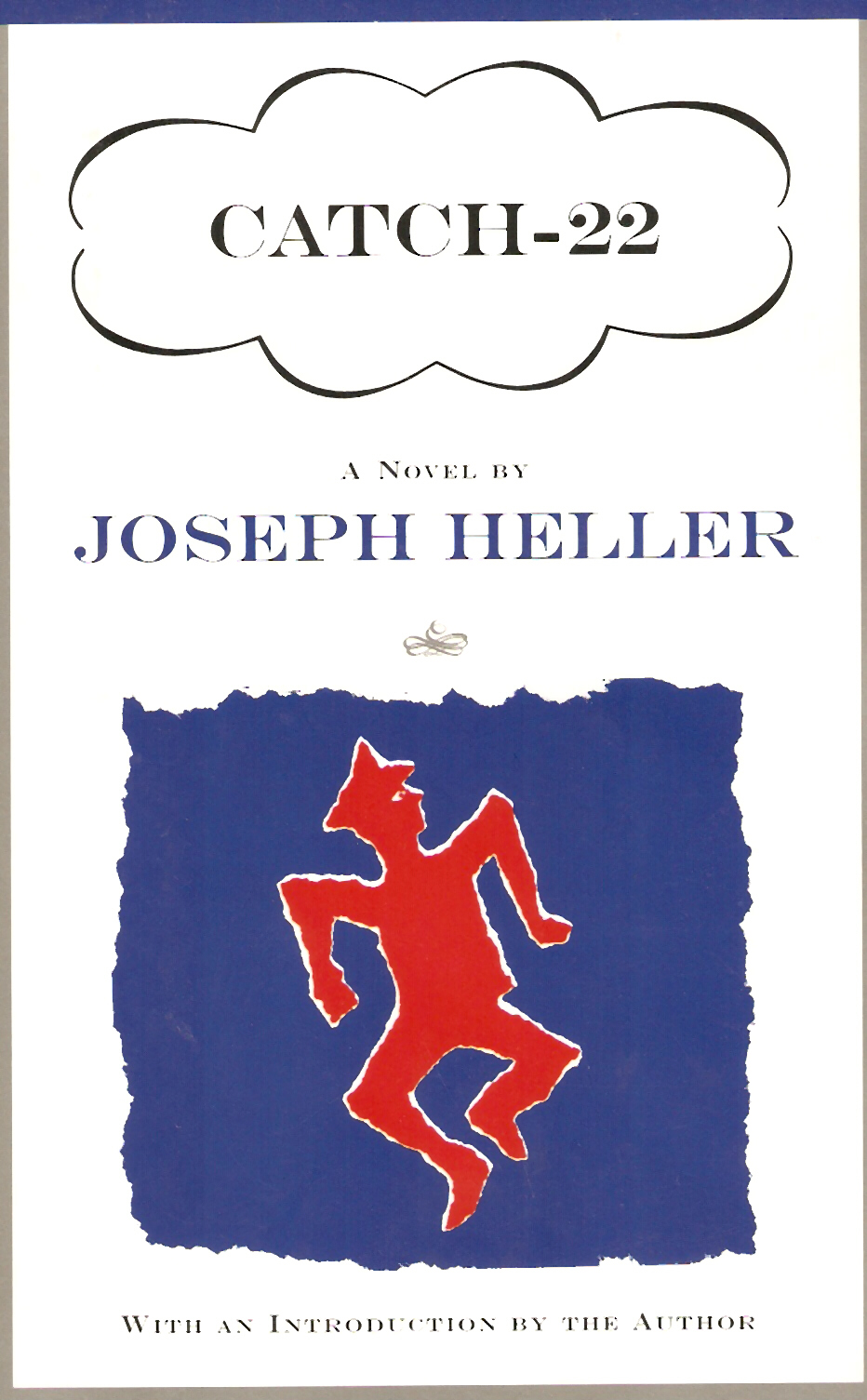
The first time I read Joseph Heller's Catch-22
 , I was very much with Yossarian, butting heads with the military/industrial establishment. But the last time I read it, I was with Orr and no longer with Yossarian until the end of the novel, when he realizes that he had it wrong all along. That his buddy, the laid-back Orr, had it right. That the only way to deal with the duality of war was to step out of it and to make a separate peace.
The first time I read Ken Kesey's One Flew Over the Cuckoo's Nest, I was with McMurphy, bucking against the totalitarian Nurse Ratchet and the bureaucracy of the establishment. But the last time I read the novel, I was with Chief Broom, the big Indian, who escaped and made a separate peace with the world.
The line containing "a separate peace" in Hemingway's A Farewell to Arms
 (where Henry escapes from the madness of World War I by going to Switzerland) was the source of the title of John Knowles' 1959 coming of age novel, A Separate Peace
 (in which peace is finally achieved through forgiveness).


 . But the gun is not shown in the opening paragraph. Instead we see what's really important to the story at hand, and what's really important to humanity in a mythic and universal context.


 Wendell Berry, in
  , like Dorothy Sayers, argues for a balance.