Showing posts with label the denial of death. Show all posts

Saturday, October 1, 2011

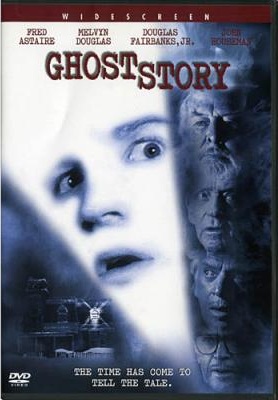
GHOST STORY, Peter Straub, novel, movie, soundtrack, analysis

"Guilt is like a witch's spell.  Once cast it cannot be reasoned away." --Reed Farrel Coleman, Walking The Perfect Square

The truth of that aphorism buzzes around in my own head as I once again read Peter Straub's Ghost Story--in which the guilt is diffuse, contagious, absorbing, pervasive.  Like the annoying deer flies that come right back to light on you no matter how many times you've brushed them off, no matter how many you've swatted dead.

That's no deer fly on the first edition dustjacker cover, but rather a wasp which the shape-changing personification of the guilt has morphed into, having previously been seen in the novel as different witch/women and then a lynx.

I prefer the art on the cover to the left, which shows the shape-shifting woman/lynx.  When different men of the Chowder Society confront her and ask her who she is, she replies, "I am you," which means that she is that part of their minds which are respectively suppressed--mostly their collective guilt for a deed long buried in the past, but also at times their sexuality and the suppressed animal side of their nature--which is where the lynx comes in.

The movie abandons the lynx, as it abandons the other incarnations of the woman, to retain the one, Alma Mobley.  I at first greatly preferred the book, but now the nuances of the movie blur into the novel and my interpretation can no longer do without either one of them.

Some critics said that it looked like John Houseman was the only one having any fun in the movie, but I think that this was by design.  The macabre is everywhere twined with irony and dark humor.  Actor Melvyn Douglas is discussed in the text of the 1979 novel, then he appears as a main character in the 1981 movie.

Two of the five members of the Chowder Club are named Hawthorne and James respectively, a tribute to Nathaniel Hawthorne and M. R. James.  Nathaniel Hawthorne provides the book's first epigraph:  "The chasm was merely one of the orifices of that pit of blackness that lies beneath us, everywhere."  R. D. Jameson provides the second epigraph: "Ghosts are always hungry."

No blurbs adorn the rear dustjacket of the first edition.  Instead there are the simple opening lines of the novel in a bold black font:
"What was the worst thing you've ever done?"
"I won't tell you that, but I'll tell you the worst thing that ever happened to me...the most dreadful thing..."

I'm astonished by the number of people who say that they don't get this, even after reading all those later allusions to Narcissus in the novel.  The speaker who answers has no empathy.  His sense of responsibility is missing--either unevolved or suppressed by his self-aggrandising vanity.

But the members of the Chowder Society have reached the autumn of their lives, and their fear of death, long in denial and projected onto the other in their stories, suddenly becomes the mirror in which they can plainly see themselves.  In turn, one by one, they are destroyed by their own fear of annihilation.


The entire cast of Ghost Story is excellent.  Melvyn Douglas would only survive another year, dying in 1981.  Fred Astaire, then eighty and only a year into his marriage to his young wife, Robyn Smith, lived well until 1987.  John Houseman, two years younger than Astaire, died in 1988.  Douglas Fairbanks, jr., died of a heart attack at age ninety in the year 2000.  Patricia Neal (who played Astaire's wife) died in 2010.

The movie was also blessed with a great soundtrack, now an annual October feature at our house.  Spooky, moody strings that seem to have a dark joy of their own.  Composer Phillipe Sarde must be some kind of conjurer himself.

Thursday, September 29, 2011

Friday's Forgotten Book: WALKING THE PERFECT SQUARE by Reed Farrel Coleman

I know I'm late to the party on this one, but after reading it, I came on-line and read every review of it I could find.  I also read the author interviews.  As highly praised as it is, I still think it is greatly underestimated.

The book involves a missing person, and the dustjacket art on the first-edition hardcover represents the idea of the missing man's face on a poster, Jack O'Lantern generic.  Have you seen this man?

The first epigraph is:  "To be is to be perceived. -- Berkeley."

The second epigraph quotes the lyrics to Graham Parker's rock song, "Nobody Hurts You."

Together the epigraphs suggest problems with identity, are we what others perceive?  Or is "to be" merely to perceive ourselves?  The last line of the song says that nobody hurts you like you do yourself.  Taken with the title, the question might be, do we walk the perfect square for the sake of others' perceptions or for ourselves?  The perfect square might suggest the missing man, dancing in the estimation of others, trying to live up to a false ideal.

But listen to the opening segment.  It is a college drama class assignment, written by the now missing man, entitled "The Lie of Wetness."  He wrote,

"You know what it's like?  I'll tell you.  You ever been to one of those fancy amusement parks like Busch Gardens or Hershey Park?  Then you'll know what I'm talking about.  At those parks they have those huge flume rides...they go like ten stories straight up in the air, swoop around a curve, then come flying...down into a big basin of water.  The boat slams into the water...and boom!  This freakin' wall of water soaks everything and everybody for like hundreds of feet around.  Well, it's like that.  Not the ride, exactly, but the waiting in line.'

"So you're standing there waiting your turn as this big line snakes around...and you're watching boat after boat go up that freakin' ramp and come splashing down.  And there's like signs everywhere...Be aware:  You WILL get wet.'

"It's not like you need those signs either, because everybody you see getting off the damn ride's so wet they could wring out their sunglasses and make a puddle.  But see here, this is the point I'm trying to make about how it is:  even though you watch everybody getting soaked and there's those signs that tell you you're going to get soaked, you tell yourself that you're not gonna get wet.  Nope, not you!  Somehow, all of a sudden, you're waterproof as Jesus in plastic slipcovers.'

"But then it's your turn.  And you stick your feet into the boat and there's like six inches of standing water there and you're up to your ankles in it.  Then it dawns on you:  the signs weren't lying.  And unlike Jesus, the water's gonna walk on you.  So you look at the bald guy next to you and his toothless girlfriend or the mom and her frightened kids two rows up or the fat retarded guy in the tight tee shirt sitting alone behind you and you wonder how many other people getting on that ride with you told themselves the lie of wetness.'

"Well, that's my point, you see.  It's like that, just like that.  We don't come with slipcovers, so we lie to ourselves instead..."

Searching on Google just now, I could not find a review which commented on the opening.  No interviewer asks about it either.  It seems obvious to me that what is being discussed, the lie of wetness, is meant as the individual denial of death.  The author's choice of this opening casts its shadows on the entire novel--perhaps even on his entire series, although I've yet to read his others.

I now have both the first hardcover edition and the splendid Busted Flush Press trade paperback.  The latter has a nice foreword by mystery novelist Megan Abbott and an informative afterword by the author himself, talking about the evolution of his series protagonist and the authorial intention of his books.

The novel is many things, among them a period piece of 1978 with loads of historical and musical references involving the New York of that day.  The only anachronism I noted was the too early mention of Gloria Gaynor's "I Will Survive" which did not come out until October of that year and got most of its play during 1979, winning its Grammy in 1980.

Never mind that.  This is a remarkable detective novel, rich in atmosphere, gritty with a moral purpose, full of twists and turns, ultimately civilized and comforting--yet genre which pushes hard beyond the rules of genre.  I'm sorry it took me so long to discover this one for myself, but I'm now delighted to have the rest of the series to read at my leisure.

Tuesday, January 18, 2011

Off And Running Monday: The Role of Sex in the Trinity


Body, mind, and spirit.
The father, the son, and the holy ghost.
All are one.
Mystery novelist and religious author Dorothy L. Sayers, writing of the trinity as a literary device in The Mind of the Maker, said that some books are mind or spirit dominated and neglect the body, while others are body or spirit dominated and neglect the mind.  She shows how "some books are Father-dominated, some Son-dominated, and some Spirit-dominated."  She calls for a balance in fiction between body, mind, and spirit--and as she further unpacks the concept, "as Idea, Energy, and Power."

In life as in art, we should not neglect one part of the trinity for another.  Living the life of the mind, we should not neglect the body.  The body contains the sensuous and the sexual, and unfortunately, the sexual too often becomes dominant, neglecting the mind and spirit.  Camile Paglia, in her mammoth study, Sexual Personae (1990), argued that "Sex is the point of contact between man and nature, where morality and good intentions fall to primitive urges."

In this work, Paglia argues in favor of the Marquis de Sade and says that Freud's Oedipal Theory dominates our sexuality and our lives.  Her arguments are worth reading, but the book consists mostly of interesting inferences drawn from false premises.  Sexual desires are indeed repressed (more so in puritanical times than in the United States today), but by far the most significant thing that is repressed is our knowledge and fear of nothingness and our own inevitable personal deaths.

Paglia is well versed in Freud's writings, but she writes like she hasn't considered nor even read the writings of those brilliant psychologists who came later such as Eric Fromm, Otto Rank, and, most importantly, Ernest Becker, who won the Pulitzer Prize for his brilliant study, The Denial of Death.

Yet the body is the temple of being, and sex is a part of life.  Buddhist David Guy, author of Autobiography of my Body (pictured above), tries to sort out the role of sex versus spirituality in The Red Thread of Passion: Spirituality and the Paradox of Sex.  Wendell Berry, in Sex, Economy, Freedom & Community: Eight Essays, like Dorothy Sayers, argues for a balance.
Wendell Berry says, "The breath of God is only one of the divine gifts that make us living souls; the other is the dust.  Most of our modern troubles come from our misunderstanding and misvaluation of this dust....This madness constitutes the norm of humanity and of modern Christianity."

The problem of unbalance exists at all levels, personal relationships, community, society, ecology.  To mistreat the body for the sake of the soul "is not just to burn one's house for the sake of the insurance," nor is it just self-hatred of the most deep and dangerous sort.  The problem is that we so often value the material over the spiritual and the life of the mind over the life of the body.  What we need is balance.