Showing posts with label Cormac McCarthy. Show all posts

Sunday, February 26, 2012

THE FOUR OF CUPS, BLOOD MERIDIAN, AND THE SUBCONSCIOUS


There's a scene in the Scott Ridley adaptation of the Joseph Conrad tale, The Duellists, where the mistress of the protagonist goes to a tarot card reader to get insight into her personal dilemma.  The seer throws the decision back at her with the moon card and the path between the two dogs.  Tells her the cards say she must make her own decision.  Well done, I think.

For the decisions are not in the cards but in ourselves.  I'd be glad if I could make a living by explaining that to people.  Card reading started out as a parlor game and evolved into a method of hyped divination used by con artists to fleece the gullible.  But it is still a parlor game too, more fun than an ouija board, and the tarot cards themselves are sometimes interesting works of art.

There are authors who work tarot cards into their books as symbolic tools of the subconscious, and the most significant example of this may be in Cormac McCarthy's Blood Meridian.  In the novel, members of the gang have their fortunes told by a gypsy card reader.  The protagonist,  who is known only as "the child" and then as "the kid" and late in the novel as "the man," draws the four of cups.

Well, the legend is that McCarthy saw the four of cups in a dream, nailed to the wall of a house (which is described in the novel), not knowing what the card meant.  John Sepich, a longtime friend of McCarthy, devoted a full chapter in his famous Notes On Blood Meridian to "Tarot and Divination."  It is his opinion that the interpretation four of cups is the key to understanding the meaning of the novel.

The four of cups is a rather blue-collar, low ranking card, a bit like the four of spades in a regular deck.  Even in Stuart R. Kaplan's massively illustrated three-volume Encyclopedia of Tarot, the four of cups doesn't get much space and hardly any illustrations.  Rank is not so important in divination, however, and a card's meaning usually depends on what company it keeps.

Details vary greatly from deck to deck, but the gist of the card is this:  A young man or woman sits with their back to a tree, gazing rather blankly at three cups, which are sometimes on their sides, empty.  The idea is that of angst, a disappointment with material things.  Meanwhile, out of the sky--or out of the subconscious--a hand from out of nowhere offers a better cup, or perhaps a spiritual awakening.

Not all tarot decks conform to this narrative regarding the four of cups, but most have something like it.  Sepich cites sources to say that this card is associated with mercy and a divided heart.  That, in the McCarthy novel, it foretells the kid's later display of mercy in the desert, and it is for that reason that the Judge eventually destroys him.

There of course is more of the tarot in Blood Meridian, but the dim light of humanity that persists in the novel is built around the evolution of empathy in "the kid," who becomes "the man" in the narrative directly after giving mercy to the old woman in the desert.  Mercy was an act of free agency and marked the kid's coming of age.
Novels, like tarot cards, are subject to different interpretations, but I certainly agree with John Sepich on this.  McCarthy stresses the notion of the subconscious, and his novels are deeply layered.  If you want to know about the historical references in the novel, Sepich's work is not to be missed.  He also maintains a site, link,  on the web in association with Christopher Forbis and some other McCarthy scholars, which includes concordances of the novels.

Then too, over at Ken's Occult McCarthy site, link, there are more detailed references to freemasonry, the tarot, parodies of McCarthy's prose, and much more.  And of course, there are always many serious interpretations being discussed at the Cormac McCarthy Society, link.  I've talked about McCarthy's works in this blog several times, including a Wednesday's Western review of Blood Meridian at this link.

We've seen a surge in the number of artistic tarot decks lately, or so it seems to me.  I can recall when there were only two or three different styles available, but now they seem without number.  It would not surprise me if someone soon came up with a Blood Meridian Tarot Deck, if they haven't already done so.

Scott Ridley has been named the director of the new Cormac McCarthy movie, The Counselor--in case you haven't heard.  The cast includes Michael Fassbender and possibly Brad Pitt or Javier Bardem.  And of course McCarthy has long been said to be putting on the finishing touches to his newest novel, The Passenger.  James Franco is still trying to make movies of both Blood Meridian and Child of God

We'll see.
_______


Monday, September 26, 2011

Monday's Best Book Diary: Roger Ebert, Lisa Randall, Grant Morrison

Legendary film critic Roger Ebert published his memoir this month (Life Itself, Grand Central Publishing, September, 2011) and it is remarkable, one of the best books I have read this year.  He profiles many of the interesting people he has known during his long career.  He speaks of the evolution of his personal philosophy:

Catholicism made me a humanist before I knew the word.  When people rail against "secular humanism," I want to ask them if humanism itself would be okay with them if it wasn't so secular. . .No, I am not a Buddhist.  I am not a believer, not an atheist, not an agnostic.  I am more content with questions than answers.

Ebert also speaks frankly and incisively about the depths of his illness and his struggle to recover.  Listen to this, pp. 387-388:

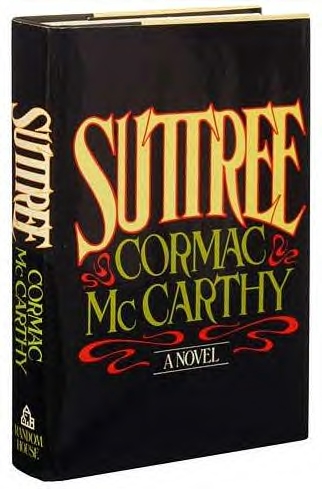
"Curiously, my love of reading finally returned after I picked up Cormac McCarthy's SUTTREE, a book I had already read not long before my first surgery. Now I read it two more times, reentering the same experience, the same occult and visionary prose, the life of SUTTREE so urgently evoked.'

"As rarely before, a book became tactile to me. When Suttree stopped at the bus station for a grilled cheese, I ate it, and the pickle, and drank the black coffee. I began to live again through this desperate man's sad life. In my chilly hospital room late at night, a blanket pulled around me in a wheelchair, a pool of light on the page, I found myself drawn into the story of Suttree with an intensity I hadn't felt from fiction in years.'

"I hungered for that book. I yearned toward it. Suttree was alive. He lived for me. How strange that a novel about such a desperate man could pull me back into living. . ."


Also added to my year's best list is Grant Morrison's SUPERGODS.  As I've never been much of a comic book reader, I was going to pass on this social history via comic books.  But then I started reading just a page or two and wound up being enthralled by the incisive ideas and the muscular prose.  I then backed off, bought the book, and started over at the beginning.

Coincidentally, just in the last week or so, I posted the cover of the original Justice League of America comic on this blog, comparing Don Winslow's Dawn Patrol to the original JLA.  I'd never thought about it before, but Grant Morrison points out that the original JLA was much like the lineup of Greek gods.  Superman was Zeus; Wonder Woman, Hera; Batman, Hades; the Flash, Hermes; Green Lantern, Apollo; Aquaman, Neptune; and so on.

I'd always considered Batman juvenile or campy at best, but after reading Morrison's detailed mythic and sociological analysis, I've decided to take a look at some of the dark Batman movies, starting with Batman Begins: The Long Halloween.

Also added to the best list:  Lisa Randall's new one, Knocking On Heaven's Door.  Randall was a guest on two segments of Charlie Rose this last month and I'm glad to have seen her.  She talks books at this link.

In her own fresh and widely informative book, she discusses the latest in scientific theories.  And she reminds us that it was Murray Gell-Mann, one of Cormac McCarthy's other scientist pals and a winner of the Nobel Prize in physics, who coined the term "quark" to describe the elementary particle, the term inspired by James Joyce's Finnegan's Wake.
 

Saturday, September 24, 2011

Another September Song.

Fall is here, the tag end of our year, the equivalent to the sunset of our day.  On the album scanned above, Dinah Washington sings of it in a voice that is ethereal and timeless:

This bitter earth
can be so cold.
Today we're young,
too soon we're old.

I like those other September songs too, such as the Kurt Weill composition most often heard in the voices of elderly men such as Willie Nelson or Jimmy Durante.  Tex Ritter with Stan Kenton's strings behind him.  The aging Frank Sinatra.

Oh it's a long, long while, from May to December
But the days grow short, when you reach September.
When the autumn weather turns the leaves to flame,
One hasn't got time for the waiting game.

Oh, the days dwindle down

to a precious few:
September. . .

November. . .
And these few precious days I'll spend with you.
These precious days I'll spend with you.


Metaphorically, fall is the conclusion of our lives, the diminishing of our powers, the dying of the light.  This metaphor is everywhere in the human universals of classic literature, sunset and autumn, the fall.  William Faulkner put the title Twilight on his greatest work, but he later changed it to The Sound and the Fury with a nod to that traditional fall tale, Shakespeare's MacBeth.  Cormac McCarthy's subtitle for Blood Meridian was The Evening Redness in the West, which of course is twilight or sunset.

We hate to see that evening sun go down.

Death is at the end of the fall, as we are each personally kicked out of paradise, in a metaphorical relationship to biblical and other mythic lore.  Legends of the Fall.  The fall starts in September and ends in December--just before Christmas as it has evolved now.  Poe was writing about this in "The Raven," to those with ears to hear it:

Ah, distinctly I remember it was in the bleak December
And each separate dying ember wrought its ghost upon the floor.

In this country, it is the holiday season.  First there is Halloween, the death before rebirth, the nightmare before Christmas.  Halloween is our day of the dead, our celebration of that which we constantly deny.  That is, we live in denial of our pending personal death yet in the constant logical certainty of it.  It is the fear of death and its simultaneous denial which drives western material civilization, causes our wars, and inspires our greatest Art.

All night sheetlightening quaked sourceless to the west beyond the midnight thunderheads, making a blueish day of the distant desert, the mountains on the sudden skyline stark and black and livid like a land of some other order out there whose true geology was not stone but fear."
           --Cormac McCarthy, Blood Meridian

Not stone but fear.  And what are we afraid of?  Lots of things, and we give them names such as the Red Threat or Weapons of Mass Destruction, but all of them, imaginary or real, are but projected substitutes for what lies at the end of them:  Death itself, the Sunset Express, and the unknown void beyond.

In this country, betwixt Halloween and Christmas, we are blessed with another wonderful holiday, Thanksgiving.  That note of love and hope at the end of Dinah Washington's This Bitter Earth, the end stanza of Kurt Weill's September Song quoted above--these belong to that spirit of gratitude connected with Thanksgiving.  I've much to say about this in relation to certain books, and I hope some readers will stick around for that.

In the meantime, I'm going to begin daily reviews of books, movies, and songs which speak of the seasonal spookiness and death, such as Adrian McKinty's Dead trilogy, John Connolly's Every Dead Thing, David J. Skal's Death Makes a Holiday, and many others.

Happy Fall, Y'all!

Monday, July 25, 2011

MOBY DICK - Gillian Anderson, John Hurt, Ray Bradbury, John Huston

We'll watch the newest incarnation of MOBY DICK on Encore/Starz when it appears this upcoming August 1st and 2nd.  Among the cast is Gillian Anderson, playing Elizabeth, Ahab's wife.  Since Elizabeth is hardly mentioned in the book, we take it that the character is re-imagined, a la Sena Jeter Naslund's novel, Ahab's Wife.

The rest of the cast includes John Hurt as Ahab, Ethan Hawke as Starbuck, Charlie Cox as Ishmael, Billy Body as Elijah, and Donald Sutherland as the Rev. Mapple.


MOBY DICK was once a forgotten book, but no more.  Now it seems to permeate our culture.  There is a seafood restaurant chain called Moby Dick.  The founder of the coffee chain, Starbucks, says that he took the name from the novel.  The book has spawned or at least inspired hundreds of other books and movies, direct derivatives.  The secondary derivatives must be without number.


Want to see how much Cormac McCarthy used Moby Dick in Blood Meridian?  Go to this link.

Peter Benchley's Jaws owes much to Moby Dick, especially Steven Spielberg's movie adaptation of the novel.  I like the Moby Dick-like interpretation of Jaws at this link.

When Spielberg made Jaws, he offered the role of Brody to Robert Duvall who only wanted to play the Ahab character, Quint. Spielberg thought Roy Scheider was too macho to play Brody (due to The French Connection), but eventually Scheider was cast as Brody and was very good in the role.

According to Wikipedia, the role of Quint was originally offered to actors Lee Marvin and Sterling Hayden, both of whom passed. "Producers Zanuck and Brown had just finished working with Robert Shaw on The Sting, and suggested him to Spielberg as a possible Quint."

Spielberg wanted a segment where Quint would be seen watching Gregory Peck in Moby Dick and laughing at him for his ineptitude. But he could not get the rights to the clip, as Gregory Peck was ashamed of his part in the movie
.


Gregory Peck was miscast as Ahab.  Melville's Moby Dick was not the icon it is today; no one wanted to back a movie of it. John Huston wanted an unknown to play the lead, but his backers would not finance the film unless he nabbed a big star. He flattered and lied and finally signed Gregory Peck, telling him that he was perfect for the part.


Ray Bradbury's novel, Green Shadows, White Whale, is not exactly a novel: it is Ray Bradbury's memories of his time spent with John Huston in Ireland writing the script for the movie.  Most of these were previously published in the form of short stories.

Bradbury recounts his difficulties with the script, his arguments with Huston, Huston's abuse of his wife, the Dublin of the time, his conjuring of Melville and the whale.  The making of the movie is itself excellent drama, with John Huston as Ahab, Ray Bradbury as Starbuck.  Ray Bradbury wrote:

"It was seven o'clock in the morning.'

"I awoke and stared at the ceiling as if it were about to plunge down on me, an immense whiteness of flesh, a madness of unblinking eye, a flounder of tail. I was in a terrible state of excitement. I imagine it was like those moments we hear about before an earthquake, when the dogs and cats fight to leave the house, or the unseen and unheard tremors shake the floor and beams, and you find yourself held ready for something to arrive but you're damned if you know what.'

"I am Herman Melville."

"Believing that, I sat at the typewriter, and in the next seven hours wrote and rewrote the last third of the screenplay plus portions of the middle. I did not eat until late afternoon, when I had a sandwich sent up, and which I devoured while typing.'

"I was fearful of answering the telephone, dreading the loss of focus if I did so. I had never typed so long, so hard, and so fast in all the years before that day nor in all the years since. If I wasn't Herman Melville, I was, oh, God, his Ouija Board, and he was moving my planchette. Or his literary force, compressed all these months, was spouting out of my finger tips as if I had twisted the faucets.'

"I mumbled and muttered and mourned through the morning, and all through noon, and leaning into my usual naptime. But there was no tiredness, only the fierce, steady, joyful, and triumphant banging away at my machine with the pages littering the floor--Ahab crying destruction over my right shoulder, Melville bawling construction over the left.'

"At last the metaphors were falling together, meeting up, touching and fusing. The tiny ones with the small ones, the smaller with the larger, the larger with the immense. . .What nailed it fast was the hammering of the Spanish gold ounce to the mast...The gold coin represents all that the seaman want, each and every one...The men do not know it, but the sound of the maul striking the coin's fastening nail is their sea coffin lid being hammered flat shut."

Saturday, May 14, 2011

Friday's Forgotten Book: Eoin McNamee's RESURRECTION MAN

Eoin McNamee is just one among several fine established authors of emerald noir, but he has lately become my favorite of them all.  His books are all still little known gems in the United States.  With each successive book, he soars in my estimation.  Let me tell you why you should be reading him too.

I can remember back a few decades ago, when we all sat around complaining that no one was writing like Faulkner anymore.  Fiction was in a state of fluff.  The new books that publishers were churning out all seemed superficial, commercial, fads and flavors of the month.  No one seemed to be dealing with the major human issues anymore, and brilliant prose seemed largely a thing of the past.

Along came Cormac McCarthy.  For many years, he was a recluse, a writer's writer; his books had small printings and even remaindered copies were scarce.  Back in 1993, a small gathering of scholars and academic professionals formed a society to further study and promote his parables.  Like Faulkner, McCarthy dealt with the universals, the eternal cycles, the human condition with its naturalistic violence and almost constant war.  And he wrote beautifully, always with an eye for the fleeting transcendent, for the dim eternal light beyond this temporal vale of darkness, beyond the scope of formal language.

Then the world at large began to read his work, more so every year.  In a thread at the Cormac McCarthy Society site, I used to maintain a list of those authors who said that their own work was in some measure inspired by McCarthy, but after a few years the list grew so fast that I could no longer keep up.  McCarthy's name also seems to be invoked fairly often as some sort of comparable yardstick in the reviews of first-time authors, some of whom may never have even read McCarthy.

In any event, not many of the novels compared with Cormac McCarthy pan out as such, but fortunately some do.  Eoin McNamee's 1994 novel, Resurrection Man, is among the very best of them.  For openers, I love the dustjacket on my copy of the hardcover edition (scanned above), the complicit mixture of light and doppelganger shadow, with the subtitle "a novel" buttoned into the shadow in blood red.  The illustration fits the subject matter of the novel.

The beauty of the novel is the telling, the prose, in the point of view which sees its frail humans with so much insight and compassion.  There is humor here too, in the irony of complicity in the face of denial.  Some people may be put off by the raw descriptions, as with McCarthy's novels, but this is an anti-violent novel of violence, ultimately a cautionary tale which tells it like it is, naturalism in parable.

I'm not saying that you'll see any Cormac McCarthy in Resurrection Man yourself, but to this reader, at times, McNamee takes on a McCarthyesque point of view, a way of seeing:

"A steamshovel reared in solitary abandonment against the night sky.  Cross here.  By frograils and fishplates where engines cough like lions in the dark of the yard.  To a darker town, past lamps stoned blind, past smoking oblique shacks and china dogs and painted tires where dirty flowers grow.  Down pavings rent with ruin, the slow cataclysm of neglect, the wires that belly up pole to pole across the constellations hung with kitestring, with bolos composed of hobbled bottles or the toys of smaller children.  Encampment of the damned."

That's from Suttree, which I think of now again when reading Eoin McNamee:

"The Harland and Wolff cranes are visible from everywhere in the city.  Scaffolding abandoned from the beginnings of the world.  A helicopter moved across the city with a searchlight picking out threadbare taxi companies and shops shuttered as though in the aftermath of looting.  Each lit area noted for its history of riot, pogrom, act of reprisal.  The Brickfields.  Smithfield."

I wouldn't say that this cinematic point of view is quite optical democracy, but it does see all with a subtle sense of compassion, like the Oversoul in the prologue to Suttree.  Down these streets no soul shall walk save you.

Eoin McNamee also turned his novel into a screenplay for a movie starring James Nesbitt, Stuart Townsend, John Hannah, and Geraldine O'Rawe--no doubt one you've never seen.  Don't miss out on the experience of reading the book, but later you may want to see the movie too--it is very well done.  Splendid acting all the way around, a nice soundtrack of seventies tunes mixed with Vivaldi, and several scenes stand out.  There is considerable graphic violence, so be warned there.  The ending might have you and your wife arguing about what happened and what it all means.  And that's a good thing.

Tuesday, April 19, 2011

Wednesday's Western: The First Gothic Western: JACK LONG or SHOT IN THE EYE by C. W. Webber


The first gothic western was published in February, 1845, as Jack Long, or Shot In The Eye by C. Wilkins Eimi--and a bit later, in a different format, under the author's real name, Charles Wilkins Webber.  It was highly praised by Edgar Allan Poe, who compared it favorably with Nathaniel Hawthorne's fiction.  The author prefaces the story by saying that it is a true tale, that he was there in Texas during the time.

The use of alternative titles was already something of a standard for western narratives written by engaging liars, something parodied well by Cormac McCarthy in Blood Meridian, or The Evening Redness in the West.  Texas historian C. L. Sonnichsen researched and wrote about the historical details behind the Regulator War, and it seems that the story could be roughly true.

Webber's yarn opens during that time of the Regulators, when Texas ranchers employed mercenary lawmen to keep order.  Unfortunately, some of the Regulators abuse their power for nefarious ends and severely beat the protagonist, leaving him for dead.  After a time, Jack Long reappears in the form of a primitive wild man, and one by one he hunts the Regulators down, shooting their eyes out with miraculous shots, often at long range.

Webber infuses his story with gothic images and legendary nuances, with suggestions of both naturalism and supernaturalism.  Only when his vengeance has been "consummated" can the protagonist return to his wife and children and his peaceful pastoral existence.  The core of this story would later become a standard of the genre, in a large number of westerns such as Max Brand's The Rancher's Revenge.

Western pulps are often looked upon with distaste by more sophisticated readers, and with good reason.  With some notable exceptions, the pulps were written to formula, and that formula usually dispensed "justice" in the form of a violent comeuppance.  Personalities were usually neglected in favor of interchangeable stock characters, at once adhering to and reinforcing stereotypes.   Usually a good guy/bad guy duality was artificially drawn and the plot manipulated with coincidence and melodrama, the white hats predictably prevailing.  Yet some very good books have been written using imaginative variations of the formula, in parody or parable.

Pre-dating the pulps were the western narratives, biased Davy Crockett-styled yarns told in the form of often flowery history and embellished autobiography.  Both Chamberlain and Webber wrote this kind of narrative.

Although Jack Long, or Shot In The Eye is a delightful find, many of Webber's other books are not only hard to find, they are hard to read, though interesting for the historical puzzles they present.  Much more interesting is the history of the man himself as naturalist, theological and medical expert, soldier, author, editor, and as a character in his own books.

Was Charles Wilkins Webber the model for Samuel Chamberlain's Judge Holden?  Cormac McCarthy's Judge Holden is based upon Samuel Chamberlain's quasi-historical memoir which includes a narrative of an 1849 scalp-hunting expedition with a man he calls Judge Holden, scientist, naturalist, and yarn-spinner, whose existence can't be verified in the census--nor so far in any other historical document.

Chamberlain says that Holden was wanted under another name for an outrage he had committed on a young girl in the Indian territories, suggesting that Holden had at least one alias.  We know that Webber wrote under different names, including Charles Winterfield and C. Wilkins Emmi.  The 1849 scalping expedition described by Samuel Chamberlain may not exactly jibe with the 1849 southwestern expedition undertaken by Webber, but we have far too little evidence to go on.  Much of Chamberlain's narrative is factual--collaborated with other historical documents--but like Webber's narratives, it often falls into dubious melodrama.    


Webber was said to have been friends with John James Audubon and his sons, and with that other naturalist/explorer, Alfred Jacob Miller, whose illustrations of pastoral American Indian life were published in Webber's books on naturalism, auctioned off at this link.

The Wikipedia link for Webber is here, but more can be found at this link from the Dictionary of Literary Biography.  And there is my own truncated list of sources related to Webber and the other filibusters at Amazon, here.


All of the internet sketches seem to have their source in the Cyclopedia of American Literature available at this link at Google Books.  Written back when such histories were notoriously unreliable, it still contains what may be valuable clues, an autographed sketch of Charles Wilkins Webber, and information on his association with Audubon.

But I'd like to see some primary documentation, some collaborating documentation.  What was his wife's maiden name?  On which of his trips to the Rocky Mountains did he meet Audubon?  And in what years?  Webber was 36 when he was killed.  That would make him 30 in 1849, and just 19 or 20 when he rode with Jack Coffee Hays and the Texas Rangers.

I first ran into Webber decades ago when I was researching filibuster Capt. Jack Allen, who raised a couple of companies in Louisville, Kentucky in 1855 for the set purpose of joining William Walker in his conquest of Nicaragua.  One of the local contemporary newspapers carried an editorial description lauding one of Allen's officers.  Charles Winterfield stopped by the newspaper office to chat, a very large man, and "every inch a hero."  An acclaimed author, naturalist, and scholar.

Later I found a roster of the two companies leaving Louisville by steamboat for New Orleans.  Some of the men were convicted murderers let off by the courts under the condition that they join the filibusters.  I was puzzled because there was no man named Winterfield on the list.  In a deposition in a Jefferson County (Ky) Circuit Court case, another man on the expedition referred to Winterfield as "Winterfield or Holden as he is called."


Researching contemporary records, I compiled mini-biographies of the Kentuckians in this expedition by each name, but a couple of decades passed before I realized that Webber and Winterfield were the same man.  Was he also Chamberlain's Judge Holden?

Webber also seems to have been affiliated with Holden's Dollar Magazine, briefly discussed by Pulitzer Prize winning author Perry Miller in The Raven and the Whale: Poe, Melville, and the New York Literary Scene, p. 226, who says that the mysterious publisher Holden went west and died in California, causing the magazine to fold.  Well, when did he go west and how did he die?

I went to Google Answers when the beta model came out, and I presented the mystery of the identity of Holden/Webber at large to researchers and reference librarians as an open question there.  No one has come up with anything that I hadn't already seen, but one researcher insisted that if Webber got married in Boston in 1849, he could not have been on a western expedition in 1849.  Furthermore, the Cyclopedia info says that the Comanches ran off the horses at Corpus Cristi and Webber never made it past Washington--therefore Holden was a fiction, case closed.

Well, it is not as simple as that.  Holden may yet have be found, under another name.

An historical fact, once stumbled upon, has to be walked around and looked at from all sides.  If I had a plane ticket and unlimited time, I would go find that marriage certificate, note the witnesses, the presiding magistrate, and the time of the marriage.  Then I would search all of the contemporary newspapers looking for a notice of the ceremony.  Marriage records are usually reliable, but sometimes the marriage has taken place earlier and recorded much later.

A basic name search through the back issues of the New York Times might be productive.  I don't think that has been done.  Clues might pop up anywhere.

Then again, if I had another plane ticket, I might thoroughly search the filibuster records that are down in the special collections at Tulane University, as well as any extant New Orleans records and newspapers for the time that Jack Allen's filibusters were there.  According to the little biographical information that we have, Webber met his artist/naturalist wife in New York.  Did they travel together before they were married?

Webber himself is a character in his western narrative, Old Hicks: The Indian Guide.  Is his wife the woman on the expedition, Emily L'Enville, with whom he falls in love?  His wife was an artist/naturalist and contributed sketches to his works in the manner of Alfred Jacob Miller and John James Audubon.  She outlived him and was involved in the reprinting of his books.  I've no doubt that there is more information on her than I have yet seen.

In Nicaragua, Charles Wilkins Webber, under whatever name he was going by, took a handful of Kentucky volunteers on a mission behind enemy lines at the Battle of Rivas.  All were said to have been shot down, but we know some who survived.  On page one of the Louisville Daily Courier, September 20, 1859, it was revealed that Ned Parker and a few other survivors had returned to Louisville via different routes.  Parker said that he escaped and made his way alone into Costa Rica and then into Mexico.

I'll post more on the works of C. W. Webber later. 

Sunday, February 27, 2011

Sunday's Smattering of Books Recently Read

The trinity in literature seems to be everywhere, a human universal inherited from the ancients.  We usually quote Emerson, as here, regarding this, and we delight in discovering such trinities as the furies in literary works, old and new.

Body, mind, and spirit.  Child, adult, and parent.  Id, ego, and superego.  A tool of interpretation with many variations, many parallels.


Peter Matthiessen, on page 41 of The Snow Leopard (Penguin Classics): "One "I" feels like an observer of this man who lies here in this sleeping bag in Asian mountains; another "I" is thinking about Alex; a third is the tired man who tries to sleep." Matthiessen tells the same tale three ways in his Pulitzer-winning Shadow Country (Modern Library Paperbacks), divided into three parts but all are one.


Robert Penn Warren showed the three "I" viewpoints in different ways in his greatest novel All the King's Men, as in this passage:
"It was like the second when you come late at night and see the yellow envelope of the telegram sticking out from under your door and you can lean and pick it up, but don't open it yet, not for a second. While you stand there in the hall, with the envelope in your hand, you feel there's an eye on you, a great big eye looking straight at you from miles and dark and through walls and houses and through your coat and vest and hide and sees you huddle up way inside, in the dark which is you, inside yourself, like a clammy, sad little foetus you carry around inside yourself. The eye knows what's in the envelope, and it is watching you to see you when you open it and know, too. But the clammy, sad little foetus which is you way down in the dark which is you too lifts up its sad little face and its eyes are blind, and it shivers cold inside you for it doesn't want to know what is in that envelope. It wants to lie in the dark and not know, and be warm in its not-knowing."
"The end of man is knowledge, but there is one thing he can't know. He can't know whether knowledge will save him or kill him. He will be killed, all right, but he can't know whether he is killed because of the knowledge which he has got or because of the knowledge which he hasn't got and which if he had it, would save him for another time. There's the cold in your stomach, but you open the envelope, you have to open the envelope, for the end of man is to know."
When we read a novel and identify with the protagonist and feel the emotions of the novel, we do so with one "I."  When we observe the protagonist, reflecting on the novel, interpreting its meaning, we do so with a different "I."
---------------------


The Lust for Blood: Why We Are Fascinated by Death, Murder, Horror, and Violence by Jeffrey A. Kottler (2011), 310 pages, including notes, bibliography, and index.


Jeffrey A. Kottler, PHD, "is a practicing psychologist, professor of counseling at California State University, Fullerton, and the author of more than seventy-five books, including the New York Times bestseller, The Last Victim: A True-Life Journey into the Mind of the Serial Killer."


Too often less of an argument than a survey of the way our culture is entertained by violence, The Lust For Blood is good but for my taste a bit too windy and too circumspect (as if to go easy on the pop, soundbite audience) to forcefully answer the question that the subtitle poses.  Dr. Kottler concludes:


"It is indeed the fear of death, the need for stimulation, and instinctual aggression that are at the core of our fascination with violence. There may come a day when human beings no longer require such stimulation in excise of our demons and purge ourselves of hostility. In the meantime, we live in the prisons of our own making, defined by our personal codes of honor and morality, as well as the choices we make for how we entertain ourselves."


I like what he says, but of course the need for stimulation and escape is also caused by repression, the denial of death.


Such entertainments as Reservoir Dogs and The Wild Bunch are briefly discussed. When, in the sub-chapter discussing these two, Cormac McCarthy gets mentioned, it is not Blood Meridian that gets quoted, but instead The Road.  And Dr. Kottler too separates the "I" of the observer from the "I" of the vicarious protagonist:


"Sam Peckinpah, who laid the groundwork for the violence in cinema of his generation, heartily agrees with Tarantino. In his films Wild Bunch and Straw Dogs, the public outcry only fed greater interest. Audiences appeared to clamor for the privilege of paying money to be horrified. Peckinpah claimed his films were actually antiviolent since they portray human behavior at its most base, primitive, and awful. 'And yet there's a certain response that you get from it, an excitement, because we're all violent people, we have violence within us."


"As previously mentioned, there is also a control element to the experience of viewing such films. You have the power at almost any moment to moderate the level of arousal you are feeling. If you become too terrified by what is happening on the screen, you always have the option to remind yourself that it is only a movie. Look at your watch. Close your eyes. Sneak a peek at your phone. Stretch. Reorient yourself. It's not real. It's not happening to me."


"If, on the other hand, you are feeling bored and disengaged from the film and want to ratchet up the excitement, then you can pretend that it is real. Jump in with both feet. Imagine that it's you who is running, hiding, or fighting. What would you do in this predicament?"


"This happened to me recently while attending a horrifying and disturbing movie about the end of the world as we know it. I think at one point I started to shut down because I was so freaked out. I kept looking at my watch and yawning. I started thinking about the set design and the camera angles, admiring the acting, wondering about how the special effects were designed. I was in perfect control--or so I thought at the time."


"But with an hour left to go, feeling restless and bored, I thought, What the hell, and slipped back into the narrative without my seatbelt attached. The film became so real for me that when the lights came back on, I was still there. I couldn't stop crying and couldn't even explain to my son why I was so upset."


"The film was The Road , based on Cormac McCarthy's story about a father's legacy to his son in a post apocalyptic world. I couldn't stop thinking about what I would do in such circumstances, what I would do to survive and protect my own family against marauding killers. And I couldn't stop crying because, for me, even a week later, the movie hadn't yet ended; I was still living it."


"Did I get my money's worth from an entertainment experience that still haunts me and invades my dreams and fantasies? You betcha. But I also lost control and I'm still paying for it."
_________


Lately I've been preoccupied with Stephen Greenleaf novels.  I began back at his first novel, Grave Error, and studied all of his novels straight through again.  I read them mostly with my observer eye this time, noting the nuances, the language, the little things, and recalling my first experiences of immersing myself into these novels, one by one, gladly forking over hardcover prices as soon as they appeared.  Greenleaf was a stylist too, with a wonderful sense of humor.


Stephen Greenleaf said (in the interview at this link) that his first novel was as much like those of Ross MacDonald as he could get it ("I'm surprised he didn't sue me.").  His narrator was mostly impersonal consciousness making its way into the case at hand, with no ego to get in the way of observing others.  As the novels progress, Greenleaf's protagonist/first-person narrator develops more and more of his own identity and personal motivations.  The great attraction of these novels (for me, at least) was his civilized voice.  Unlike so many private eyes, he wasn't a self-interested capitalist, nor a macho tough guy, nor a Sherlockian puzzle solver.  He was a seeker, a blue-collar social critic, reflective, introspective, and humble.

A lawyer himself, Greenleaf mostly made fun of lawyers in these books.  Tanner points out an occasional exception, including an old friend he goes to see in Past Tense.  The lawyer's office had been totally redecorated since the last time Tanner was there, with everything now in the western motif.  Tanner asks his friend, why the change?

"Cormac McCarthy," his friend says.  Tanner says that his friend acted surprised that he even knew who McCarthy was.

I had to laugh out loud when I first read that passage, back when Past Tense came out in 1998.  That same year McCarthy came out with Cities of the Plain.  McCarthy had won the National Book Award but was still a relatively unknown recluse back then--except to a core of loyal readers.  I remember going online to the Cormac McCarthy Society Forum and posting that excerpt there.

Stephen Greenleaf's books were always a special treat for this reader.  Highly intelligent and written in a sparkling style, they were always well reviewed as such.  But they didn't sell well.  Greenleaf tried different things and different publishers, but finally after  sixteen novels (fourteen Tanner novels and two stand alones), Greenleaf reluctantly quit writing and went back to lawyering.  He still doesn't even have his own wikipedia page.

Forgotten?  Not by his core of loyal readers, and good gosh, we miss him.  In his last novel, Ellipsis, he said goodbye to his readers with a satire on the publishing industry--before his own ellipsis.  This novel is written with his usual humor and asides and it also includes some special little things that you have to read very closely to catch.  I think I'll devote a Friday's Forgotten Book blog to it soon.

Sunday, February 13, 2011

Cormac McCarthy's SUNSET LIMITED on HBO

This week's debut of the Tommy Lee Jones and Samuel Jackson starred play garnered mixed reviews.

The "novel in the form of a play" is part My Dinner with Andre part the bridge scene in It's a Wonderful Life (60th Anniversary Edition).

R. Bull is credited with that cover showing a stylized human face on the universe, which is fitting for this play on the human condition, two suns in the sky as eyes for the two ways of seeing, the old testament and the new, Yahweh and Elohim, yin and yang, the material and the spiritual.

Of course, the work that Sunset Limited really begs comparison to is Samuel Beckett's Waiting For Godot.  The characters are always going somewhere but never getting anywhere, perpetually hung in the same dilemma.

Lois Gordon, in her marvelous work, Reading Godot, illuminates this dilemma, but it up to the individual to solve this riddle for himself.  My other favorite study of this is Paul Foster's Beckett and Zen: A Study of Dilemma in the Novels of Samuel Beckett (Wisdom East-West Book. Grey Series)Past, present, future.  Body, mind, spirit.  Father, son, and holy ghost.  Superego, ego, and id.  McCarthy's early style was Faulkner, the middle style was Hemingway, and the late style is Beckett.