Legendary film critic Roger Ebert published his memoir this month (Life Itself, Grand Central Publishing, September, 2011) and it is remarkable, one of the best books I have read this year. He profiles many of the interesting people he has known during his long career. He speaks of the evolution of his personal philosophy:
Catholicism made me a humanist before I knew the word. When people rail against "secular humanism," I want to ask them if humanism itself would be okay with them if it wasn't so secular. . .No, I am not a Buddhist. I am not a believer, not an atheist, not an agnostic. I am more content with questions than answers.
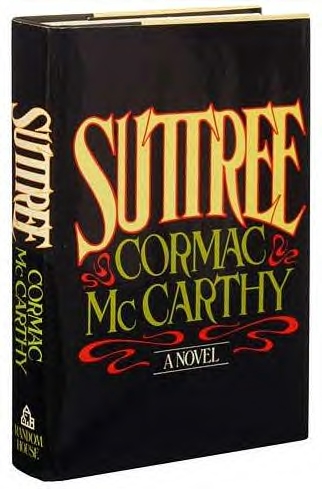
"Curiously, my love of reading finally returned after I picked up Cormac McCarthy's SUTTREE, a book I had already read not long before my first surgery. Now I read it two more times, reentering the same experience, the same occult and visionary prose, the life of SUTTREE so urgently evoked.'
"As rarely before, a book became tactile to me. When Suttree stopped at the bus station for a grilled cheese, I ate it, and the pickle, and drank the black coffee. I began to live again through this desperate man's sad life. In my chilly hospital room late at night, a blanket pulled around me in a wheelchair, a pool of light on the page, I found myself drawn into the story of Suttree with an intensity I hadn't felt from fiction in years.'
"I hungered for that book. I yearned toward it. Suttree was alive. He lived for me. How strange that a novel about such a desperate man could pull me back into living. . ."

Eoin McNamee is just one among several fine established authors of emerald noir, but he has lately become my favorite of them all. His books are all still little known gems in the United States. With each successive book, he soars in my estimation. Let me tell you why you should be reading him too.
I can remember back a few decades ago, when we all sat around complaining that no one was writing like Faulkner anymore. Fiction was in a state of fluff. The new books that publishers were churning out all seemed superficial, commercial, fads and flavors of the month. No one seemed to be dealing with the major human issues anymore, and brilliant prose seemed largely a thing of the past.
Along came Cormac McCarthy. For many years, he was a recluse, a writer's writer; his books had small printings and even remaindered copies were scarce. Back in 1993, a small gathering of scholars and academic professionals formed a society to further study and promote his parables. Like Faulkner, McCarthy dealt with the universals, the eternal cycles, the human condition with its naturalistic violence and almost constant war. And he wrote beautifully, always with an eye for the fleeting transcendent, for the dim eternal light beyond this temporal vale of darkness, beyond the scope of formal language.
Then the world at large began to read his work, more so every year. In a thread at the Cormac McCarthy Society site, I used to maintain a list of those authors who said that their own work was in some measure inspired by McCarthy, but after a few years the list grew so fast that I could no longer keep up. McCarthy's name also seems to be invoked fairly often as some sort of comparable yardstick in the reviews of first-time authors, some of whom may never have even read McCarthy.
In any event, not many of the novels compared with Cormac McCarthy pan out as such, but fortunately some do. Eoin McNamee's 1994 novel, Resurrection Man, is among the very best of them. For openers, I love the dustjacket on my copy of the hardcover edition (scanned above), the complicit mixture of light and doppelganger shadow, with the subtitle "a novel" buttoned into the shadow in blood red. The illustration fits the subject matter of the novel.
The beauty of the novel is the telling, the prose, in the point of view which sees its frail humans with so much insight and compassion. There is humor here too, in the irony of complicity in the face of denial. Some people may be put off by the raw descriptions, as with McCarthy's novels, but this is an anti-violent novel of violence, ultimately a cautionary tale which tells it like it is, naturalism in parable.
I'm not saying that you'll see any Cormac McCarthy in Resurrection Man yourself, but to this reader, at times, McNamee takes on a McCarthyesque point of view, a way of seeing:
"A steamshovel reared in solitary abandonment against the night sky. Cross here. By frograils and fishplates where engines cough like lions in the dark of the yard. To a darker town, past lamps stoned blind, past smoking oblique shacks and china dogs and painted tires where dirty flowers grow. Down pavings rent with ruin, the slow cataclysm of neglect, the wires that belly up pole to pole across the constellations hung with kitestring, with bolos composed of hobbled bottles or the toys of smaller children. Encampment of the damned."
That's from Suttree, which I think of now again when reading Eoin McNamee:
"The Harland and Wolff cranes are visible from everywhere in the city. Scaffolding abandoned from the beginnings of the world. A helicopter moved across the city with a searchlight picking out threadbare taxi companies and shops shuttered as though in the aftermath of looting. Each lit area noted for its history of riot, pogrom, act of reprisal. The Brickfields. Smithfield."
I wouldn't say that this cinematic point of view is quite optical democracy, but it does see all with a subtle sense of compassion, like the Oversoul in the prologue to Suttree. Down these streets no soul shall walk save you.
Eoin McNamee also turned his novel into a screenplay for a movie starring James Nesbitt, Stuart Townsend, John Hannah, and Geraldine O'Rawe--no doubt one you've never seen. Don't miss out on the experience of reading the book, but later you may want to see the movie too--it is very well done. Splendid acting all the way around, a nice soundtrack of seventies tunes mixed with Vivaldi, and several scenes stand out. There is considerable graphic violence, so be warned there. The ending might have you and your wife arguing about what happened and what it all means. And that's a good thing.
Last week on Transcendental Tuesday, link, I posted about the Trinity, quoting Emerson and others about this human universal in myth, religion, and literature. On Thursday, link, I posted about the dark side of the trinity as it symbolically appears in literature as the furies, as exemplified in novels by Joseph Conrad, Austin Wright, and Cormac McCarthy.
William C. Spencer wrote about the dark trinity of Outer Dark in his essay, "Cormac McCarthy's Unholy Trinity: Biblical Parody in Outer Dark," published in the anthology Sacred Violence: Cormac McCarthy's Appalachian Works
 edited by Wade Hall and Rick Wallach. Spencer wrote, "Just as Hawthorne's Young Goodman Brown encounters a diabolical figure in the dark forest who remarkably resembles himself, Culla encounters the three hellhounds that embody his own inner darkness."
The dark trinity of repressed human animal nature shadows Culla in the novel in italics until the end, the repressed inner darkness then coming into the outer darkness. They are the murderers as well as the leaders of the lynch mob in search of the murderers.
edited by Wade Hall and Rick Wallach. Spencer wrote, "Just as Hawthorne's Young Goodman Brown encounters a diabolical figure in the dark forest who remarkably resembles himself, Culla encounters the three hellhounds that embody his own inner darkness."
The dark trinity of repressed human animal nature shadows Culla in the novel in italics until the end, the repressed inner darkness then coming into the outer darkness. They are the murderers as well as the leaders of the lynch mob in search of the murderers.
The first three McCarthy novels, The Orchard Keeper , Outer Dark, and Child of God
 , on the larger scale, are about the evolutionary fall of consciousness into animal man, bringing with it the knowledge of death and the subjective moral sense of good and evil.
Before the Fall, the alpha animal man procreated with every available female--mothers, sisters, and daughters included--and fended off all comers like the farmer in Child Of God. The incest in Outer Dark goes back to that, as natural as that between the sons and daughters of Old Testament Adam and Eve. The eclipse in Outer Dark symbolizes the Oedipal fear that the son will eclipse the father.
That McCarthy also ingeniusly incorporated his own history into Outer Dark is eloquently argued in Jay Ellis's book, No Place for Home: Spatial Constraint and Character Flight in the Novels of Cormac McCarthy (Studies in Major Literary Authors).
, on the larger scale, are about the evolutionary fall of consciousness into animal man, bringing with it the knowledge of death and the subjective moral sense of good and evil.
Before the Fall, the alpha animal man procreated with every available female--mothers, sisters, and daughters included--and fended off all comers like the farmer in Child Of God. The incest in Outer Dark goes back to that, as natural as that between the sons and daughters of Old Testament Adam and Eve. The eclipse in Outer Dark symbolizes the Oedipal fear that the son will eclipse the father.
That McCarthy also ingeniusly incorporated his own history into Outer Dark is eloquently argued in Jay Ellis's book, No Place for Home: Spatial Constraint and Character Flight in the Novels of Cormac McCarthy (Studies in Major Literary Authors). There are many other different and excellent interpretations of this as well.
William C. Spencer, the McCarthy scholar mentioned above, is also the man who first talked about McCarthy's novel, Suttree , as being an incarnation of the life of the buddha: Suttree, born into a wealthy and influential family, renounces his privledges and goes to live among the downtrodden where, bodhisattva-like, he takes on the sufferings of other sentient beings. The italicized prologue suggests that "no soul shall walk save you," and Suttree later says that "It is not only in death that all souls are one." Spencer argued that Suttree transcends at the end of the novel, after overcoming his fear of death.
They say it is an eloquent paper, but no hard copy of it is to be found either at the Cormac McCarthy Society or on the internet. William C. Spencer, then an English professor at Delta University, cannot now be found, it seems. Perhaps someone who knows him will see this and let us know.
John Cant, author of Cormac McCarthy and the Myth of American Exceptionalism (Studies in Major Literary Authors) , gives a Christian interpretation of Suttree. But he also sees the Eternal Feminine in the novel in the form of the trinity, Wanda, Joyce, and Mother She. Cant says:
"The Great Mother was typically represented in three manifestations, nymph, matron, and crone. Suttree encounters all three; Wanda is the numph, Joyce the matron, and Mother She the crone. The latter is the Queen of the Underworld; the Goddess presides over both life and death, each passing into the other continuously. It was the loss of this epistemology that brought to man the need for 'resurrection,' the conquest of death."
The use of the Trinity is, of course, widespread in literature. This last sunday, I reviewed the newly published book of interviews with Tom Robbins who discusses his novel, Another Roadside Attraction , published over twenty years ago. Robbins says that his character Amanda is "a manifestation of the triple aspects of the universal goddess--maiden, slut, and mother/wife--as connected to the earth as any mushroom."
Animal man, middle man, spiritual man. McCarthy may have wanted to style his body of work as a trilogy containing other trilogies. His first three novels were an animal man trilogy, as Denis Donoghue has pointed out in his book, The Practice of Reading . Suttree is a stand-alone novel, autobiographical and both historical and literary. Blood Meridian starts with "See the child." and ends with the kid being transformed into a man after giving compassion to the imaginary crone in the desert, and then transformed again by death via the materialist Judge.
The western trilogy is about the middle man, and at the end of the trilogy McCarthy turns to spiritual man. The greater trilogy of his entire work is thus far animal man, middle man, spiritual man, and although certainly not a perfect fit, it resembles the general arc of the work of James Joyce, and before that, of Dante.
. Suttree is a stand-alone novel, autobiographical and both historical and literary. Blood Meridian starts with "See the child." and ends with the kid being transformed into a man after giving compassion to the imaginary crone in the desert, and then transformed again by death via the materialist Judge.
The western trilogy is about the middle man, and at the end of the trilogy McCarthy turns to spiritual man. The greater trilogy of his entire work is thus far animal man, middle man, spiritual man, and although certainly not a perfect fit, it resembles the general arc of the work of James Joyce, and before that, of Dante.
McCarthy's writing style has changed with each phase, the animal man phase being a jungle of words in a Faulkner-like style, the heroic western trilogy leaning to the Heminwayesque, and the spiritual phase leaning to Samuel Beckett's minimalist style.
Trilogies within trilogies, arcs within arcs.